Most founders still treat launch day as the marketing plan. They prepare one announcement, publish it everywhere, and hope attention turns into signups. That approach creates pressure without creating a learning system.
Product launch marketing works better as a continuous, measurable cycle of positioning, distribution, activation, and iteration. A software launch should produce qualified visits, signups, and activated users, not just views and likes. Short-form video helps when founders use it to test messages repeatedly, not when they treat one polished teaser as proof of demand.
Rethinking the Software Product Launch
The perfect launch day is mostly a myth. A strong announcement can create attention, but attention has a short half-life. If the landing page is unclear, the promise is weak, or the product doesn't deliver value quickly, a large audience won't rescue the launch.
Historical launch data supports a more cautious view. A review of 19 peer-reviewed studies covering new-product performance from 1945 through 2004 found commercial failure rates generally between 30% and 49% in its review of new-product performance. The pattern stayed persistent across periods, with approximately 42% of launches failing during 1985 to 1989, 40% in 1995, and 46% during 2003 to 2004. McKinsey's analysis also found that more than 50% of launches failed to hit their business targets, even though new products contributed more than 25% of total revenue and profits across industries, as reported in the same source.
Those figures don't mean every startup needs a large launch operation. They mean visibility and release aren't the same as commercial success. Founders need a system that makes the next message, asset, and distribution decision easier than the last one.
Replace the event with a learning loop
I define product launch marketing as a sequence of hypotheses:
- Positioning hypothesis: This audience has this problem and cares about this outcome.
- Message hypothesis: This promise will make the right people stop and pay attention.
- Distribution hypothesis: This channel can reach those people with enough context.
- Activation hypothesis: The landing page and product experience can turn interest into meaningful use.
- Retention hypothesis: The first successful experience is valuable enough to bring users back.
A launch asset is useful when it helps test one of those hypotheses. A video that earns attention but attracts people who will never use the product has limited strategic value. A quieter video that brings qualified visitors and activated users can be the better asset.
Practical rule: Treat every launch asset as an experiment with a next decision attached to it.
Founders should also separate product-market-fit work from promotion. Marketing can increase the number of people who see a product, but it can't create a durable need where none exists. Teams running product market fit experiments should use launch content to test language, objections, and audience quality, not just to make the product look finished.
Build for repetition
A repeatable launch system needs assets that can be produced, tagged, published, and reviewed without restarting from zero. That might include a landing page, launch email, founder post, product community announcement, and several short videos that each lead with a different pain point.
The first version gives you a baseline. The second tests whether the opening promise is stronger. The third might change the proof point or audience framing. This process creates useful evidence while the product is still close to the people who built it.
The launch isn't over when the announcement goes live. It changes phase. Before release, you test the message and prepare distribution. On launch day, you coordinate attention and response. After release, you use behavior data to decide what deserves another push.
Building a Repeatable Pre-Launch Asset Pipeline
Manual video production creates a bad constraint for small software teams. If every new message requires a script, a recording session, editing, revisions, and exports, founders publish once and stop. A better pipeline starts with the landing page because the page already contains the product's promise, audience, visual identity, and proof.
Before generating an asset, clean the source page. Put the primary audience and outcome near the top. Replace broad claims with concrete product language. Make the call to action obvious. Add screenshots that show the product in use, not only decorative illustrations. Automated extraction can only work with the information available on the page.
Prepare the page before the video
Use this short checklist:
- Lead with the problem: State the costly, frustrating, or slow task your product addresses.
- Name the user: Say whether the product is for solo builders, engineering teams, marketers, or another specific group.
- Show the result: Explain what changes after the user adopts the product.
- Add credible proof: Use a product screen, workflow, customer observation, or clear differentiator.
- Keep one CTA: Ask viewers to join the waitlist, start a trial, book a conversation, or visit the launch page.
- Remove competing claims: A teaser can't explain every feature in a few seconds, so keep secondary details on the landing page.
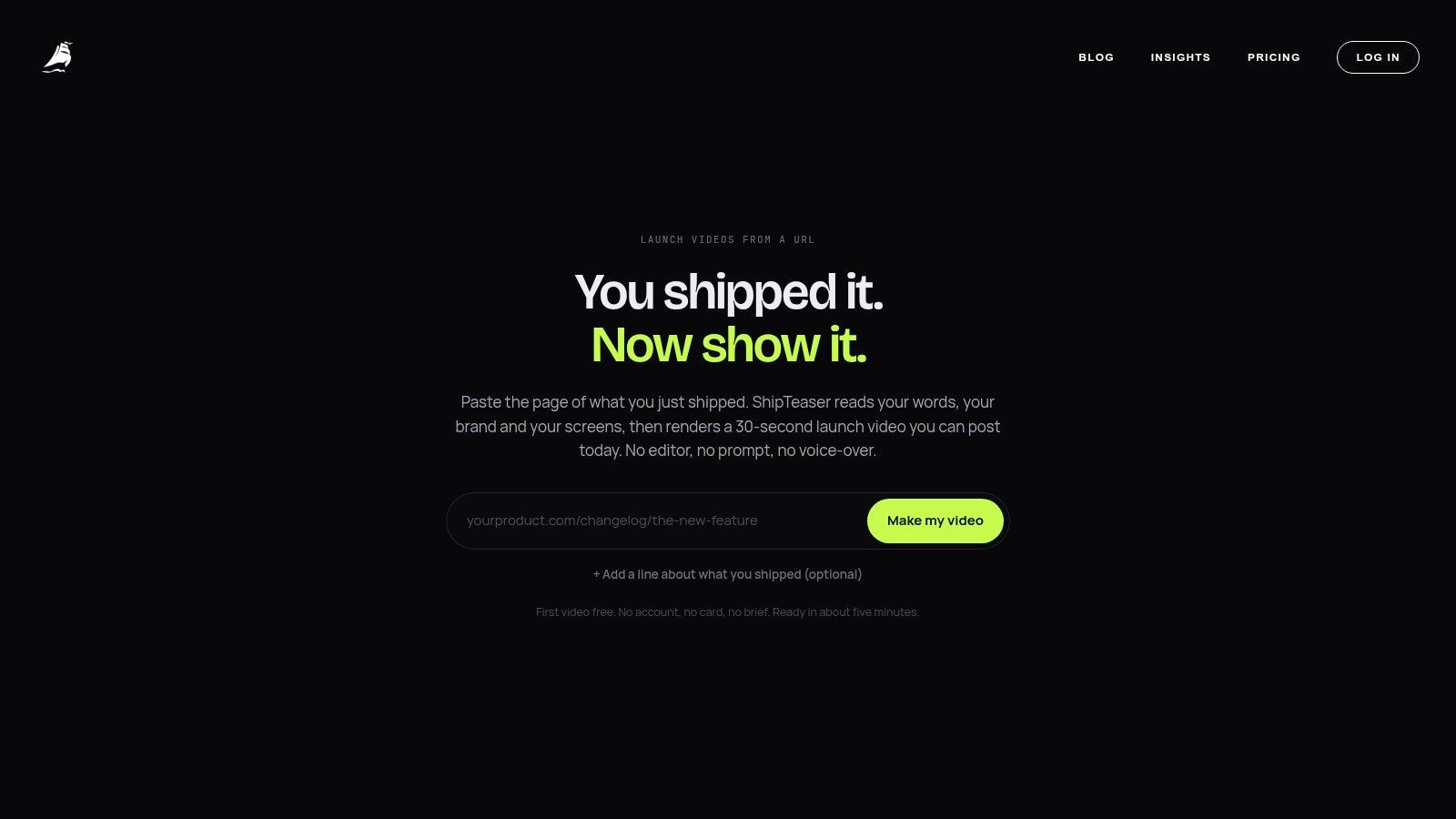
A URL-to-video workflow works best when the page has a clear narrative. ShipTeaser lets a founder paste a product URL and receive a 15-second, 1080p, silent motion-graphics teaser in about 2 minutes, with five scenes: hook, problem, solution, proof, and CTA. Silent means there's no voice-over or narration. An optional music bed can be added, and the output is designed for quick posting rather than detailed manual editing.
The available formats support different placements. Use 16:9 for wider launch pages and some professional feeds, 1:1 for square social posts, and 9:16 for vertical feeds. The service doesn't provide AI avatars, screen recording, stock footage, text-to-video from a prompt, dubbing, subtitles, translation, clip trimming, or a timeline editor. Those limitations matter because the workflow is intentionally narrow. The page supplies the source material, and the generated teaser turns that material into a concise promotional asset.
Test the opening, not everything at once
Create at least three hooks for the same product. One can focus on the painful task, another on the desired outcome, and a third on the audience's current workaround. Keep the rest of the teaser consistent so the opening is the main variable.
For example, a workflow product might test:
- “Stop rebuilding the same launch assets by hand.”
- “Turn one product page into a ready-to-post teaser.”
- “For solo builders who need launch content without an editing workflow.”
Don't change the hook, proof, CTA, colors, and audience in one batch. If the result improves, you won't know why. Controlled variation creates a useful archive of decisions rather than a pile of disconnected creative.
The same principle applies to broader launch preparation. A practical SaaS launch video workflow should connect the source page, asset name, audience, channel, and intended action. That makes each video easier to evaluate later.
Place the videos into a simple calendar before launch day. Give every version a unique campaign identifier and a matching UTM set. If you're also building a waitlist or crowdfunding-style pre-launch campaign, a repeatable asset pipeline can help you smash your funding goals by keeping the message visible while you learn which promise attracts the right people.
Here is the practical sequence:
- Finalize the landing page narrative.
- Generate several hook variants.
- Check every scene for factual accuracy and readable text.
- Export the required ratios.
- Add campaign identifiers and destination links.
- Schedule the first posts.
- Reserve later variants for follow-up tests.
Review every generated asset manually before publishing. Confirm that screenshots are current, the proof scene doesn't overstate the product, and the CTA matches the destination page. Automation reduces production work. It doesn't remove editorial responsibility.
Executing the Launch Day Distribution Sequence
Launch day is not a single announcement. It is the first controlled run of a distribution system. The goal is to learn which message, format, and channel combination creates qualified attention, conversation, and signups. Publishing the same asset everywhere at once hides those differences and makes the results harder to interpret.
Set the timing according to the launch platform's operating cycle and your team's ability to respond. Platforms that rank products across a 24-hour cycle often recommend 12:01 a.m. Pacific Time when there is no urgent timing constraint, giving the listing a full day to collect views, engagement, and support in its launch preparation guidance. Friday at 8:00 a.m. Pacific Time can suit a team that needs to participate during working hours. Choose the overnight start when someone can monitor the launch from the beginning. Choose the daytime option when live replies matter more than the longest possible cycle.
Use a timed sequence
A practical launch day sequence looks like this:
- Before launch: Check the product page, signup flow, analytics events, founder profile, and prepared replies. Upload the correct video ratio for every destination.
- 12:01 a.m. Pacific Time: Publish the product listing if the timing fits your team. Add a concise teaser and state clearly who should care.
- Morning: Publish the founder's personal announcement on a professional network. Explain the problem, the product decision, and the next action.
- Late morning: Share a shorter version on your primary short-form feed. Give it one clear point and the launch link. Do not paste the full product description into a fast-moving feed.
- Midday: Answer comments, questions, and objections. Group repeated questions, then turn them into follow-up posts or landing-page edits.
- Afternoon: Publish a new teaser hook instead of duplicating the first upload. Send the launch email to people who have already shown interest.
- End of day: Record signups, activated users, replies, and assisted conversions. Note what people asked before choosing the next asset.
Each post should have a defined job. One asset can create discovery. Another can explain the product. A third can address objections. Track those jobs separately so a high-view video does not receive credit for conversions it did not influence.
Channel selection should follow audience behavior rather than habit. Industry reporting describes short-form video feeds on major social platforms as effective distribution options, with surveyed marketers reporting effectiveness of 78%, 61%, and 59% for the leading options in this summary of video marketing research. These are survey results, not guarantees. Prepare reusable assets, then validate where qualified users respond.
Match the creative to the placement
A 16:9 video can support a launch page or a wide feed. A 1:1 version fits square placements. A 9:16 version suits vertical mobile placements. Do not stretch one export across every context if the text becomes too small or the product screen loses clarity.
Use the five-scene structure as an editing brief:
- Hook: State the sharpest reason to keep watching.
- Problem: Show the friction in plain language.
- Solution: Show what the product changes.
- Proof: Display a product screen or specific differentiator.
- CTA: Give one next action.
A silent teaser must work without narration. Use short on-screen phrases, strong contrast, and product visuals that remain clear with sound muted. Keep the frame readable. Text should support the visual argument, not replace it.
The written post needs the same discipline. Test its first sentence separately from the video hook if you want to improve your post openers. The two openings can reinforce each other, but identical wording is not required. A post may create curiosity while the video demonstrates the product.
Use email as a conversion bridge. Include the product promise, a short description of the audience, one teaser, and one CTA. A focused launch email workflow keeps the message consistent and gives subscribers a route that does not depend on feed distribution.
Run the day with clear ownership. Assign one person to monitor replies and another to watch the funnel. The founder can make product decisions, but should not also carry every comment, broken link, analytics check, and page edit. Record each meaningful result against the asset and audience that produced it. That turns launch day into the first experiment in a repeatable short-form video system.
Sustaining Momentum Through Post-Launch Iteration
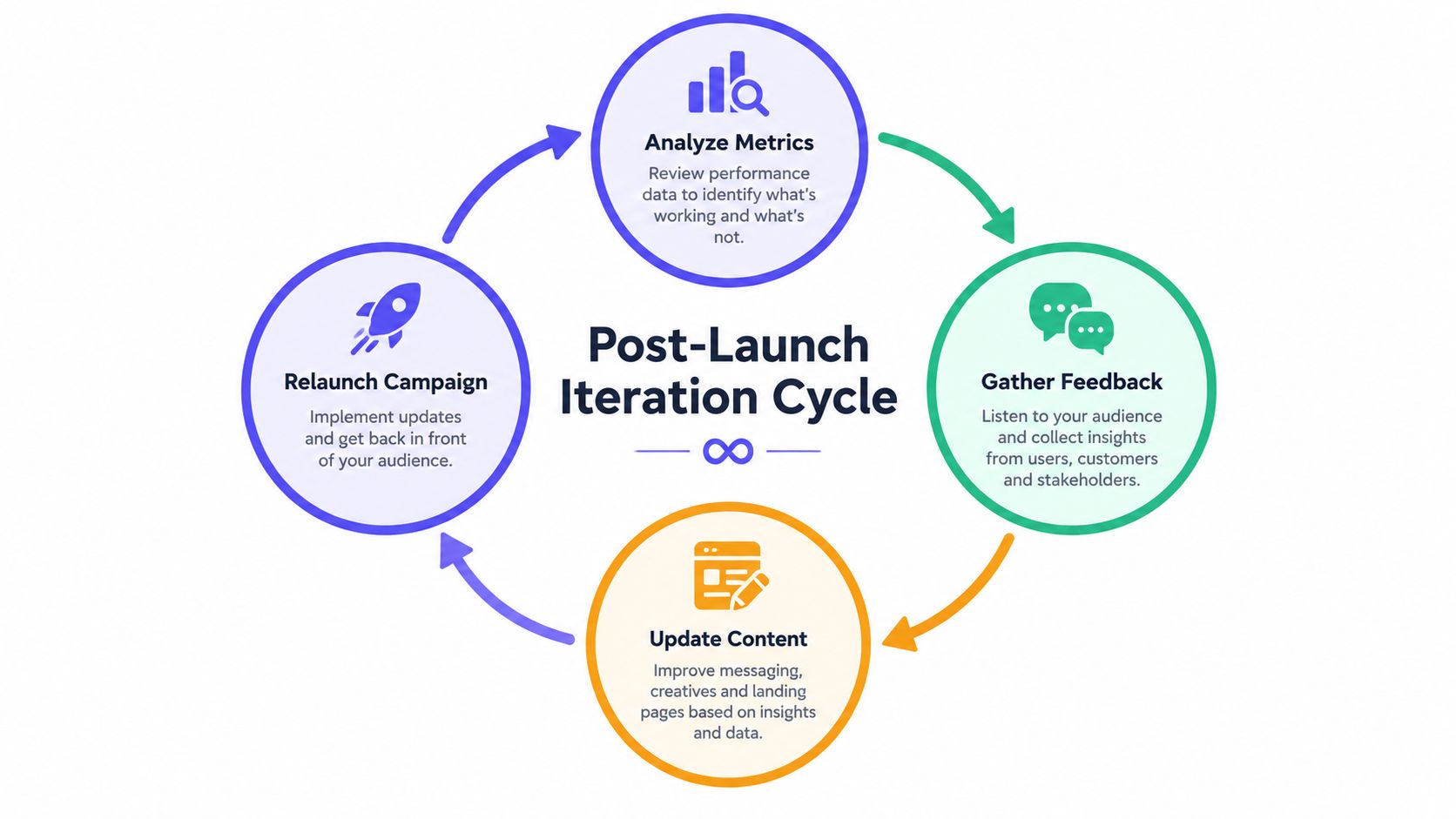
A launch spike is a starting signal, not proof of durable demand. A large study of 83,719 stock-keeping units across 31 U.S. consumer-packaged-goods categories examined products introduced from 2002 through 2009 and tracked whether they continued selling. By the end of the first year, 25% of launched products were no longer being sold. By the end of the second year, that share had reached 40% in the study summary and supporting discussion.
Software products follow different adoption patterns from packaged goods, so these figures do not forecast SaaS results. They do show why promotion cannot stop after announcement day. Repeated demonstrations, reminders, positioning tests, and refreshed creative create more chances for the right audience to discover the product. Treat each asset as part of a measurable experiment rather than as another isolated campaign.
Turn video into a testing format
Short-form video works well for iteration because the production scope stays controlled. Keep the duration consistent, then change one major variable per test. That variable could be the opening promise, proof point, CTA, or audience segment.
A disciplined 15-second sequence can follow this structure:
- Seconds 1 to 2: Establish the hook and audience problem.
- Seconds 3 to 10: Demonstrate the product or resulting benefit.
- Seconds 10 to 13: Add proof or differentiation.
- Seconds 13 to 15: Finish with one CTA.
One benchmark reported that 15 to 30-second videos achieved approximately 6.00% engagement on short-form video feeds in that benchmark, while videos over 20 minutes had approximately 20% completion in its short-form benchmark discussion. Another source reported that only 30% of short-form videos achieved an average watch rate above 81%. Short duration alone does not guarantee completion. Measurement methods and audiences vary, so use these figures as context rather than a universal target.
A useful weekly batch might contain three variants that use the same product screens and CTA. Version one leads with the time-consuming workaround. Version two leads with the desired result. Version three leads with the narrow audience that feels the problem most intensely. Reusing the production base keeps the comparison cleaner and reduces the cost of learning.
Keep the strongest hook, then inspect the weakest funnel stage. If viewers leave immediately, revise the opening. If they watch but do not click, revise the promise or CTA. If they click but do not sign up, inspect the landing page. If they sign up but do not activate, improve onboarding or product clarity. Change the part that failed instead of rebuilding the entire campaign after every result.
Choose a cadence you can maintain
ShipTeaser offers a first video free with no credit card. Its subscription plans are $99 per month for one video per week, $149 for two videos per week, and $199 for four videos per week. The right plan depends on whether the team can review and distribute the output with discipline. More assets create little value if nobody tags, publishes, or evaluates them.
A sustainable cadence can remain modest:
- Weekly: Publish a controlled variant tied to one hypothesis.
- After publication: Review retention, click-through, signup, and activation signals.
- At the next review: Keep the strongest element and revise one weak stage.
- Monthly: Refresh page copy, proof, screenshots, or audience framing when evidence supports the change.
A post-launch week plan should cover distribution and product feedback. Marketing should stay connected to the product. Questions in comments can reveal unclear positioning, missing proof, or friction in the user experience.
Frequency is not the goal. A new video should test a new angle or reach a different context. Reposting the same creative without a learning objective produces activity, not iteration. The launch becomes durable when every short-form asset creates a decision for the next cycle.
Measuring Launch Success Beyond Vanity Metrics
A launch can look successful and still fail to produce useful customers. Views arrive quickly, so teams celebrate them first. Reach alone says little about audience fit, page visits, signups, activation, or retention. A teaser that attracts the wrong audience can create more reporting noise than product demand.
Industry reporting found that 93% of marketers report positive video ROI, while only 30% quantify ROI through bottom-line sales, and many still rely on views, engagement, or awareness metrics in this review of video marketing measurement. A separate go-to-market survey found that revenue growth, conversion rate, and pipeline velocity were not the primary measures for many respondents. The operating rule is simple: define the business event before publishing the asset.
Pick one primary outcome
Choose one primary outcome for the launch cycle. That might be activated users, qualified trials, paid conversions, or another event that shows meaningful product progress. Supporting metrics explain where the funnel weakens. They should not compete with the primary outcome.
Track the path from exposure to value:
- Impression
- Video view
- Landing-page visit
- Signup or waitlist completion
- Product activation
- Retention or paid conversion
Give every teaser a unique campaign identifier or UTM set. Use one naming convention that records the audience, hook, channel, and date. If the same video runs across several channels, keep its creative identifier stable while changing the channel values. This separates asset performance from distribution performance and makes repeated experiments easier to compare.
Use confidence intervals when comparing conversion results. Raw views can create false certainty, especially when variants reach different audience sizes. A video with more views but fewer qualified signups may have a reach advantage with no business value. A smaller audience that produces more activated users deserves further testing.
The best launch metric is the one that changes your next decision.
Use a hierarchy instead of a dashboard dump
| Metric Type | Examples | Strategic Value |
|---|---|---|
| Awareness | Impressions, reach, video starts | Shows whether distribution created exposure |
| Attention | Completion rate, watch time, click-through rate | Helps diagnose the hook and message |
| Intent | Qualified visits, signup rate, waitlist completion | Shows whether the audience understood the offer |
| Activation | Activated users, qualified trials, first meaningful action | Connects the campaign to product value |
| Business outcome | Paid conversion, assisted pipeline, retained usage | Shows whether the launch supports growth |
Reported short-form engagement rates vary by channel and measurement method. One benchmark placed short-form feeds around 2.60% on one platform and around 0.48% on another in its short-form video benchmark discussion. Treat those figures as context, not targets. Use completion rate and click-through rate to diagnose the creative, then focus the operating review on cost per activated user and activation rate.
A high-view video is weak when it attracts poor-fit viewers or fails to create downstream intent. A lower-reach teaser can perform better when it brings qualified users who activate. That distinction matters for small teams. Time spent optimizing applause is time not spent improving acquisition quality or product use.
Use a product launch metrics framework alongside campaign identifiers, landing-page analytics, and activation events. Review results on a fixed schedule, then assign the next experiment to the weakest stage. Low impressions point to distribution. Low views point to the hook. Low clicks point to the promise. Low signups point to the page. Low activation requires an examination of onboarding and product value.
A launch is not one verdict delivered on launch day. It is a measurable sequence of short-form tests, each producing evidence for the next decision.
Frequently Asked Questions
When should a software founder launch on Product Hunt?
Product Hunt recommends launching at 12:01 a.m. Pacific Time when there isn't an urgent timing constraint, because the product gets the full 24-hour launch day to accumulate views, engagement, and support. Friday at 8:00 a.m. Pacific Time is another option for founders who want daytime momentum. Choose the time your team can actively support, answer questions, and respond to feedback.
Should a 15-second teaser include narration?
A 15-second teaser can work without narration when the visual sequence, on-screen copy, and product screens explain the value with the sound off. Use a clear hook, keep the text readable, and show the product or outcome quickly. A silent format can include an optional music bed, but don't depend on audio to communicate the core promise.
How often should founders create new launch videos?
Create new variants when you have a specific hypothesis to test, not merely because a calendar says to post. A weekly batch can work for a solo builder if each version changes one major element and the founder reviews the funnel afterward. Keep the strongest hook, then revise the weakest stage, whether that's opening retention, click-through, signup conversion, or activation.
What should a founder measure first?
Choose one primary outcome, such as activated users, qualified trials, or paid conversions. Then track the path from impression to video view, landing-page visit, signup, activation, and retention. Views and completion rate help diagnose the creative, but activation rate and cost per activated user are more useful for deciding whether the launch is creating business value.
Can one teaser be used on every channel?
One core teaser can be adapted across channels when the export matches the placement. Use 16:9, 1:1, and 9:16 versions as needed, and check that product screens and text remain readable in each ratio. Keep the campaign identifier consistent, but use channel-specific links so you can compare qualified actions and assisted conversions.
ShipTeaser turns a product URL into a 15-second, 1080p silent motion-graphics teaser with hook, problem, solution, proof, and CTA scenes, ready to post in multiple ratios. Start with the free first video, test one launch message, and visit ShipTeaser to build a repeatable asset pipeline for your next software release.