Launching a product is the coordinated, multi-week work of putting a finished product in front of a defined audience so strangers can discover it, understand it, and try it. Releasing a product is a single moment when code goes live. Launching is everything before and after that moment that turns availability into adoption.
What It Means to Launch a Product
Most founders picture launch day the same way. The product is built. The landing page is live. You post on X, submit a listing, refresh your analytics, and wait for strangers to arrive. By evening you've had encouragement from friends, a few clicks, and almost no sign-ups. Nothing broke. The launch just never happened in any meaningful sense.
Launching a product is the coordinated, multi-week work of putting a finished product in front of a defined audience so strangers can discover it, understand it, and try it. A launch has a named audience, a clear promise, assets built for each channel, and a way to measure whether attention turned into first use. Releasing is a date on a calendar. Launching is a sustained push with goals and evidence.
Releasing Is Not Launching
Shipping code is releasing. Nobody owes a new product attention, and a feed post doesn't create a distribution system. When your launch or launching work starts weeks earlier, you're seeding early users, testing language, and preparing follow-up for people who click but don't convert on the first visit.
That distinction changes what you prepare. A release needs a working product and a page. A launch needs more:
- A defined audience: One specific group with one problem you can name in a sentence.
- A single promise: The outcome a stranger should understand within seconds of landing.
- A sequence of assets: Teasers, posts, and emails timed across weeks, not dumped on one day.
- A measurement plan: Tracking links and activation events set up before traffic arrives.
Working through a structured resource helps you catch gaps early, and Bulby's product launch checklist is a useful reference for founders who want to audit their preparation before committing to a date.
If nobody outside your existing network can find the product and explain what it does, you released it. You didn't launch it.
The Goals a Product Launch Is Built Around
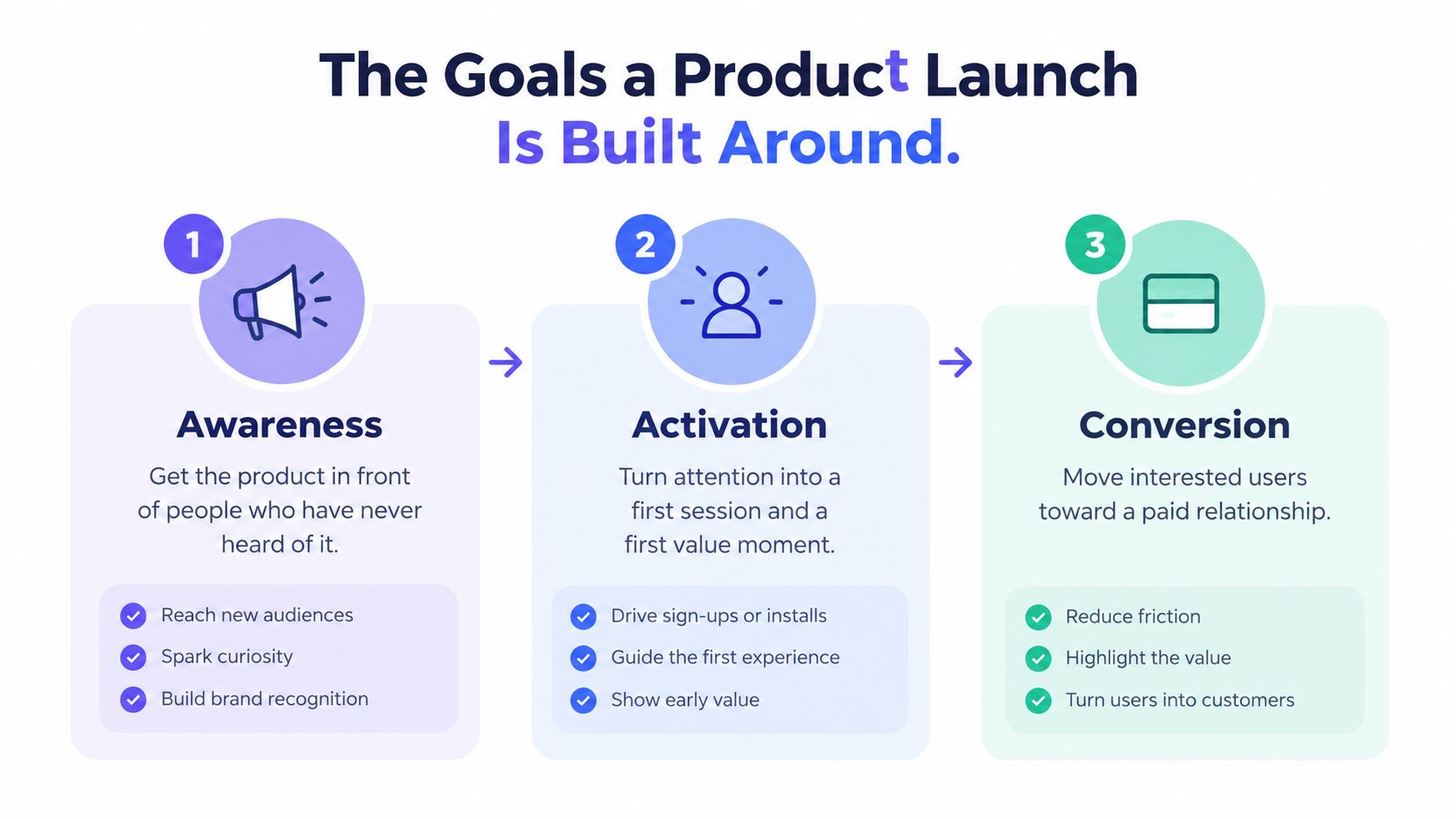
A launch serves three goals in sequence. Each one depends on the previous one, and confusing them is how founders waste weeks. A post built for awareness can't be judged by paid conversions. An onboarding fix can't be judged by impressions.
Awareness Comes First and It's Expensive in Attention
Awareness means getting the product in front of people who've never heard of it. That's harder than most founders expect because the commercial environment is crowded at a global scale. The World Intellectual Property Organization reported approximately 11.7 million trademark applications worldwide in 2024, with technology and research representing 19.3% of global non-resident filing, the largest sector share, according to data summarized in the global trademark filing figures for 2024. New software products compete for names, identities, and attention in the most crowded category there is.
That context should shape channel choices. Founders deciding where effort belongs can compare their thinking against guidance on where to launch your product and against broader startup launch insights from NZ Apps, which cover go-to-market planning for early teams.
Activation and Retention Prove the Product Works
Activation is the first session where a user reaches the core value, not just an account creation. Retention is whether that user comes back after the novelty fades. Awareness without activation means your message promised something the product didn't deliver quickly. Activation without retention means the first experience worked but there's no recurring reason to return.
Use a simple test for every planned activity. Name which of the three goals it serves. A teaser video serves awareness. An onboarding checklist serves activation. A weekly digest that brings users back to their data serves retention. If an activity maps to none of the three, cut it, however fun it sounds. Launch calendars fill up with tasks that feel productive and move nothing.
The cut test: If you can't say whether a launch task drives awareness, activation, or retention, it probably drives none of them.
A Realistic Product Launch Timeline
A credible launch runs six to eight weeks from first seeding to the end of active promotion, with measurement continuing after that. Launch planning guidance describes this staged sequence of pre-launch seeding, hype building, launch execution, and post-launch optimization in the six-to-eight-week launch planning benchmark. Compressing that into a single announcement day removes every chance to learn and adjust.
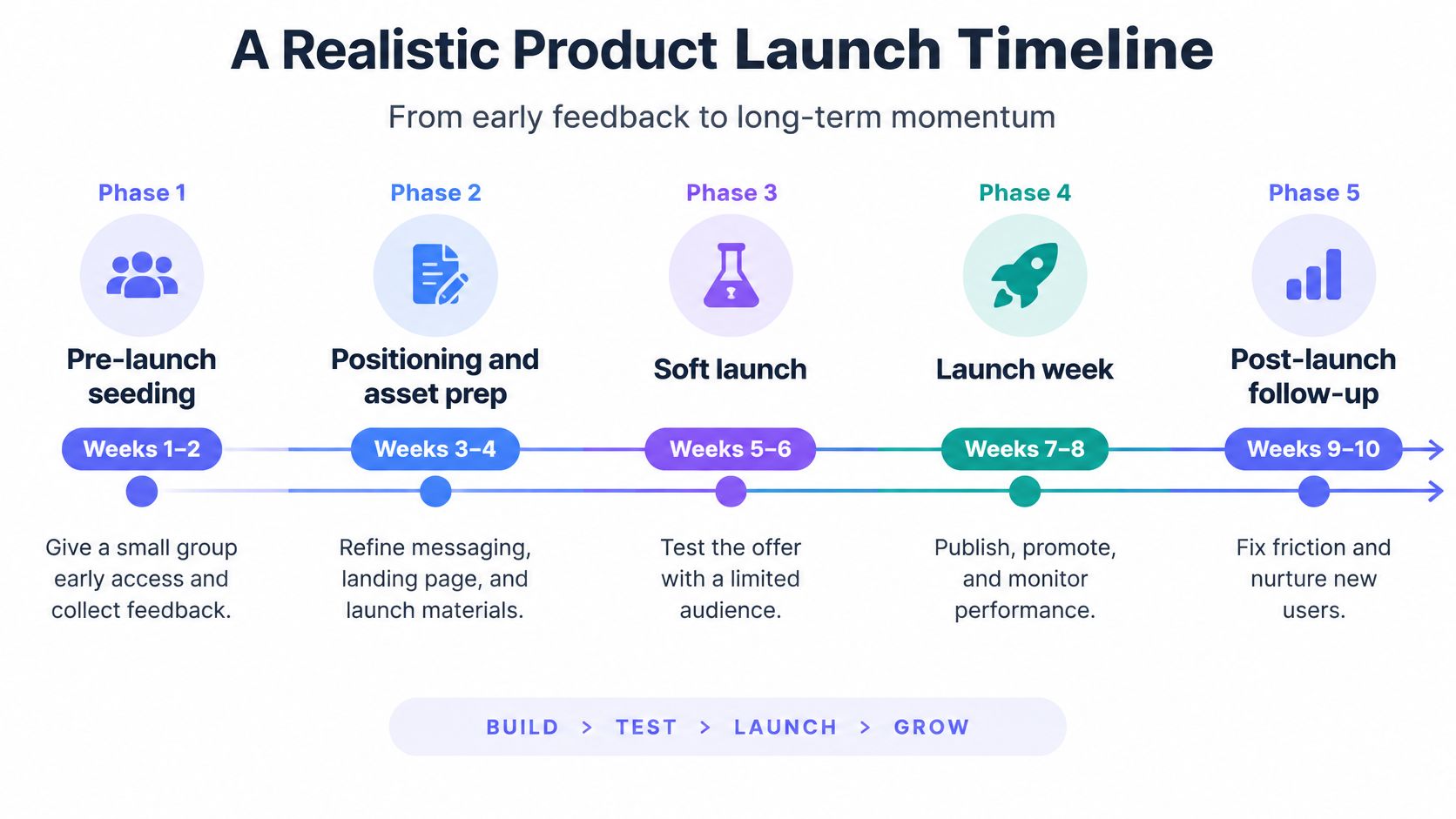
Weeks One to Three Cover Seeding and Warming
Pre-launch seeding means giving a small group early access before any public push. You're not collecting praise. You're collecting the exact words real users use to describe the problem and the outcome, because that language should end up on your landing page and in your teaser. Fix the onboarding steps where seeded users stall. Note which feature they mention unprompted.
Hype building follows, and the word hype overstates it. You're publishing a short sequence of teasers and build-in-public posts so launch day lands on a warmed audience instead of a cold feed. People who've seen the product twice before launch day behave differently from people seeing it once. Your email list matters here too, and the structure of a good launch email sequence should be drafted during this phase, not the night before.
Launch Week and the Ninety Days After
Launch execution is the coordinated day itself. Same message, same link discipline, across every channel you chose. Founders who also sell education products will recognize the same sequencing logic in guidance on pricing and selling your first course, where warming an audience before the offer opens is treated as essential.
Post-launch optimization is where most founders quit too early. Adoption commonly continues for roughly ninety days after release, so weekly asset variants and fixes during that window matter more than launch-day theatrics. Version your assets one variable at a time:
- Opening claim: Change the first line, keep everything else fixed.
- Screenshot: Swap the product view, keep the claim and call to action.
- Call to action: Test a different next step against the same creative.
One changed variable per variant is the only way you'll know what moved the numbers.
Where Short Teasers Fit in a Launch
Founders often ask one video to do every job. Introduce the product, explain the problem, demo the features, handle objections, close the sale. That video ends up long, unfocused, and unfinished. Launch assets work as a ladder, and each rung has a defined length and job. A launch-video playbook identifies teasers as typically 15 to 30 seconds, product-reveal videos as 60 to 90 seconds, and feature demonstrations as 2 to 5 minutes, as set out in the launch video length and role breakdown.
Launch Video Assets by Length and Job
| Asset type | Typical length | Job in the launch |
|---|---|---|
| Teaser | 15 to 30 seconds | Create awareness and earn the click to the landing page |
| Product reveal | 60 to 90 seconds | Tell the story for visitors already interested |
| Feature demonstration | 2 to 5 minutes | Support evaluation by users comparing options |
A 15-second teaser sits at the top of that ladder. It isn't a compressed demo. Its only job is to make a stranger care enough to click. Everything detailed belongs on the landing page and in the longer assets below it on the ladder.
Muted Autoplay Decides the Format
Feeds autoplay without sound, so a teaser must make sense in silence and the opening frame must carry the hook. This isn't a style preference. An analysis of 194 real startup launch videos found that videos with a strong hook earned about 90 times the median views of the rest of the sample, according to the analysis of 194 startup launch videos. The first seconds decide whether the remaining seconds get watched at all.
Format matters for the same reason. Social-video benchmarks report that vertical videos generate 58% more mobile engagement than horizontal videos, per the social video format benchmark data. Produce the same teaser concept in horizontal, square, and vertical rather than cropping one master file as an afterthought.
One rule governs all of this. A teaser pointing at a weak landing page wastes the attention it earns. Fix the page first. The promise in the video and the headline on the page should match closely enough that a visitor feels continuity, not a bait and switch.
Choosing How to Produce Launch Videos
Early-stage teams have three realistic routes to a launch video, and the right choice depends on how often you'll produce one. A founder launching once can tolerate a slow process. A founder testing variants weekly cannot.
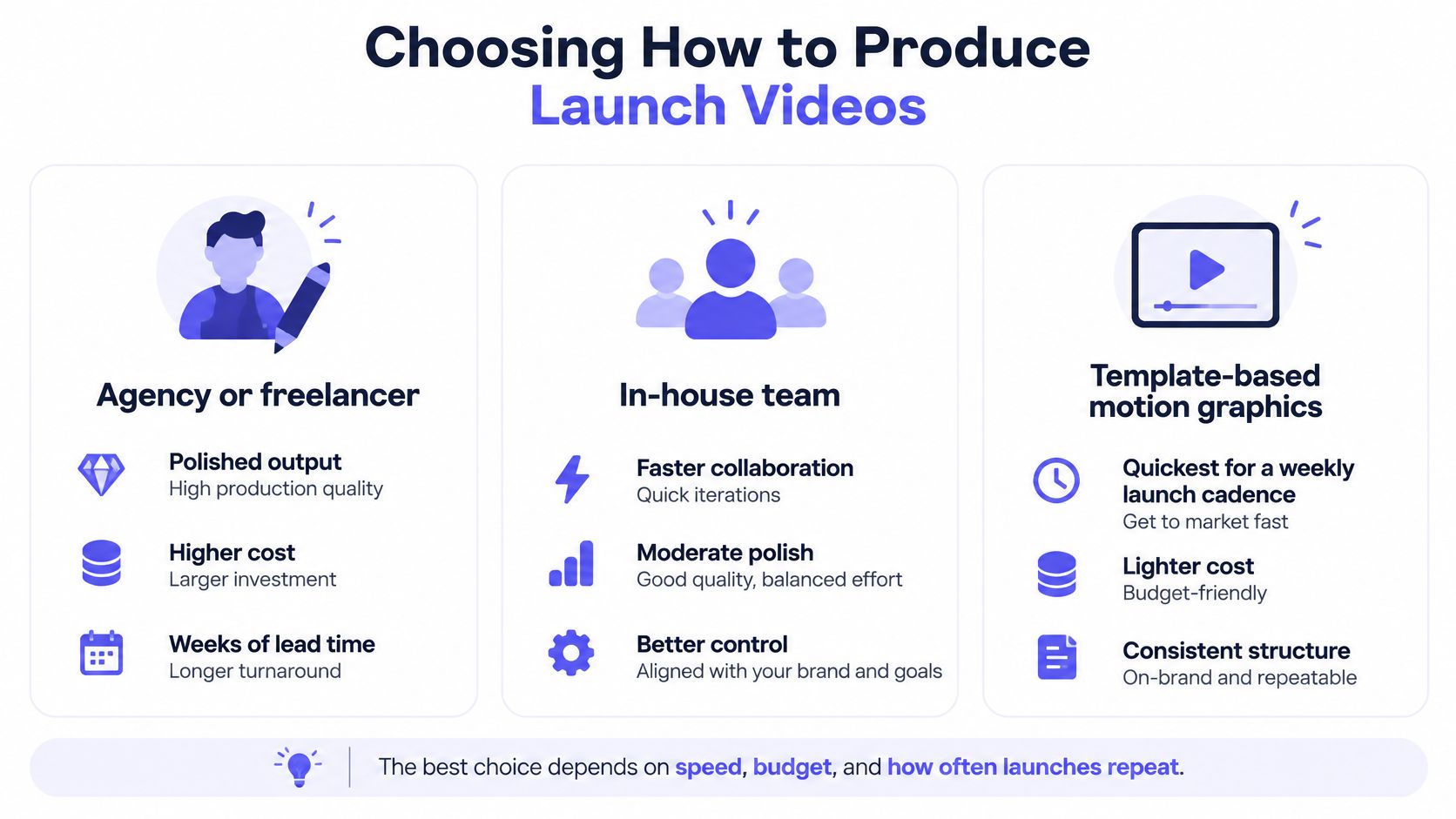
Agency Work and Manual Editing Both Break Cadence
An agency or freelancer delivers polish. The trade-off is money and lead time measured in weeks, plus revision rounds that stretch further. That's defensible for a flagship reveal video. It breaks down when you need a fresh variant every week during a ninety-day optimization window. By the time version two arrives, you've forgotten what version one taught you.
Manual editing costs little money and a great deal of time. Timeline editing is a real skill, and most solo builders don't have it and shouldn't learn it mid-launch. Every hour spent keyframing is an hour not spent on onboarding or talking to users. Before choosing either route, it's worth reviewing what production actually costs across methods in this breakdown of product video costs.
Automated Generation Fits the Weekly Variant Model
Short-form video is now standard practice rather than a specialist tactic. HubSpot's 2025 marketing data reported that 29.18% of marketers used short-form video, the most commonly used video format in that survey, and 21% said it delivered the highest return on investment, according to the 2025 short-form video adoption and ROI data. That adoption is why automated production exists as a category.
ShipTeaser is one option built for this slot. ShipTeaser takes a pasted product URL and returns a 15-second, 1080p, silent motion-graphics teaser in about 2 minutes, ready to post. ShipTeaser structures each teaser in five scenes covering hook, problem, solution, proof, and CTA, exports in 16:9, 1:1, and 9:16, and offers an optional music bed. Silent means no voice-over, which matches how feeds play video. The first video is free with no credit card. Plans run $99/mo for 1 video per week, $149 for 2 per week, and $199 for 4 per week, which maps directly onto a weekly variant-testing cadence.
Measuring Whether Your Launch Worked
A launch isn't measured by the spike on launch day. It's measured by what happens to the people who showed up. Launch guidance identifies adoption rate, retention, churn, and revenue growth as core launch KPIs in the product launch KPI guidance, and those metrics only become readable weeks after release.
The chart below shows how engagement and conversion stages connect across a launch, from first visit through repeat use.
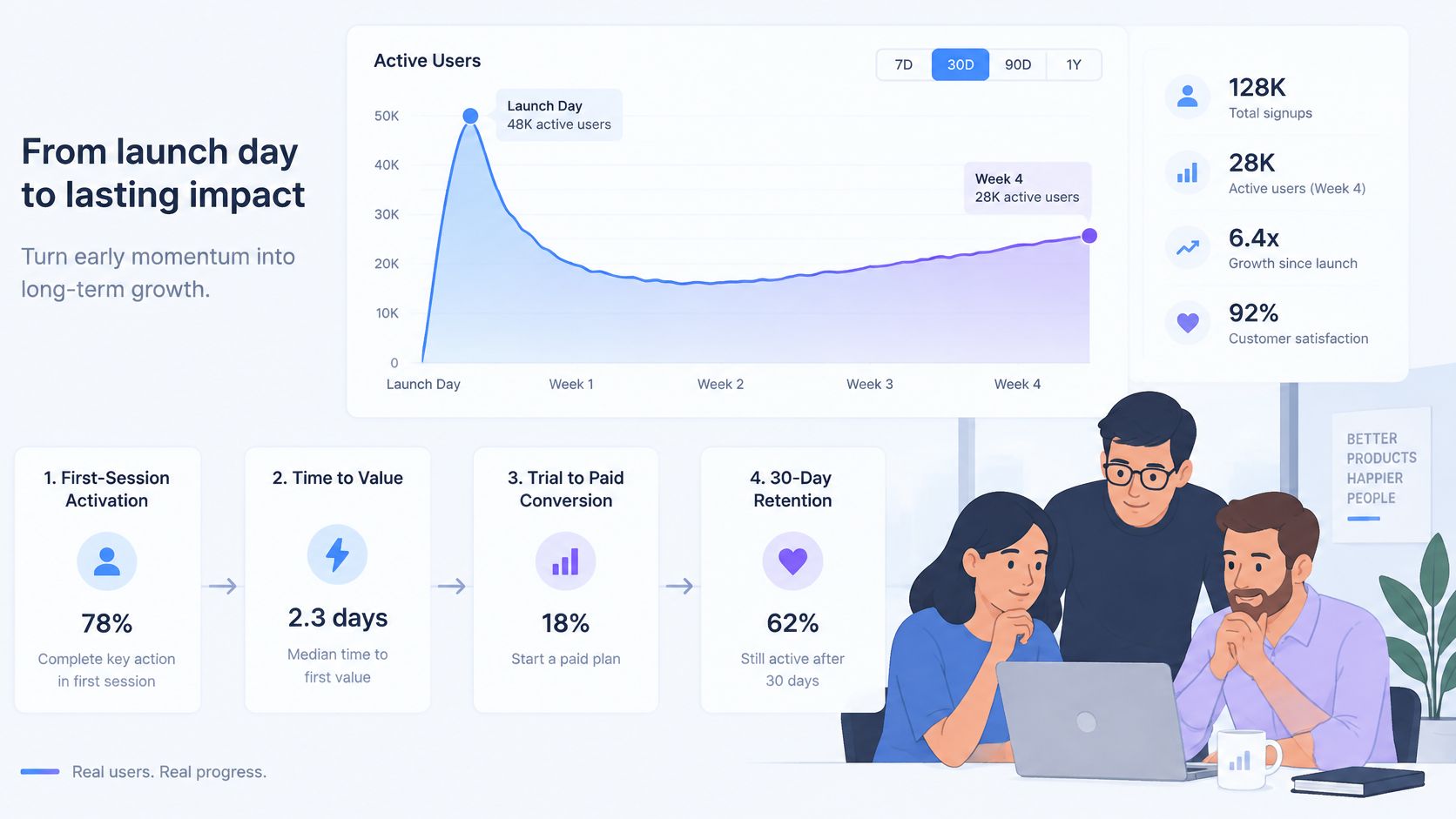
The Diagnostic Chain
Track four metrics in order and read them as a chain:
- First-session activation: Did new users reach the core value in session one?
- Time-to-value: How long did that first value moment take?
- Trial-to-paid conversion: Did activated users become customers?
- 30- and 90-day cohort retention: Did they stay?
The chain tells you where to fix things. Strong traffic with weak activation means the message and the product disagree. Strong activation with weak 30-day retention means the product delivers novelty without recurring value. Each pattern points at a different repair, which is why reading the metrics in sequence beats staring at a dashboard total. A fuller treatment of these numbers is in this guide to product launch metrics that matter.
The video below walks through how launch engagement data can be read as a funnel rather than a set of isolated totals.
Minimum Viable Measurement for a Teaser
Treat every teaser as an experiment. Define one audience and one desired action. Give every channel and every variant a unique tracking link. Review results at 24 hours, 7 days, and 30 days, and judge variants on downstream activation, not view counts. A high view count can sit on top of weak sign-ups and poor-fit traffic, and that combination costs you money while looking like success. Keep only the variants that improve what happens after the click.
Product Launch FAQ
How Long Should a Product Launch Actually Run
A product launch should run as an active six-to-eight-week sequence covering pre-launch seeding, hype building, launch execution, and post-launch optimization, with measurement continuing to roughly ninety days after release. Launch day is one event inside that window, not the whole launch. Founders who stop promoting and measuring after the first week abandon the period when adoption signals, retention data, and variant test results become readable.
Should a Teaser Go Out Before, at, or After Launch
A 15-second product teaser has a distinct job at each stage of a launch. Before launch, a teaser tests demand by showing whether a clear promise earns clicks and sign-ups from a cold audience. At launch, a teaser drives awareness across feeds where strangers encounter the product for the first time. After launch, the same teaser format works for retargeting people who visited the landing page but didn't start using the product.
Is a Silent 15-Second Video Enough Without Narration
A silent 15-second teaser is enough for the awareness job because social feeds autoplay video without sound, so the message must land through motion graphics and on-screen text alone. Silence is the correct default for feed placement, not a missing feature. The teaser should hand off to the landing page for detail, since fifteen seconds can present a hook, a problem, a solution, proof, and a call to action, but cannot replace a demonstration or onboarding.
What Is the Fastest Way to Test Launch Messaging This Week
The fastest way to test launch messaging this week is to generate one teaser from your existing landing page, post the teaser with a unique tracking link, and compare clicks and first-session activation against your current baseline. ShipTeaser produces a free first teaser from a pasted product URL with no credit card required, so a founder can run that test without hiring anyone or learning editing software. One measured variant teaches more than a month of debating copy internally.
Paste your product URL into ShipTeaser and ShipTeaser will return a 15-second, 1080p silent motion-graphics teaser in about 2 minutes, structured as hook, problem, solution, proof, and CTA in the ratio your channel needs. Your first ShipTeaser video is free with no credit card, so you can put a real launch asset in front of strangers this week and measure what it does.