K 6 learning is the structured run from kindergarten through sixth grade where children build the core skills that later schooling assumes. It matters because primary education now reaches 91.2% of children worldwide, yet minimum proficiency is far lower, with only 58% reaching minimum reading proficiency and 44% reaching minimum math proficiency by the end of primary school.
If you're a parent, you're probably looking at a reading log, a spelling sheet, or a math page and wondering, "Is this real progress, or just schoolwork getting done?" If you're a teacher, you know the harder truth. K 6 learning isn't a checklist of topics covered. It's a layered progression of skills, and weak layers show up later.
K 6 learning means children move from learning sounds, symbols, and routines to using reading, writing, math, science reasoning, and self-management with growing independence. The right way to judge K 6 learning is not "Did the child finish the year?" but "Can the child do the next level of work without heavy support?"
I'll keep this practical. Start with what K 6 learning includes, then look at what good teaching and real progress look like across grade bands.
What K 6 Learning Actually Covers
K 6 learning is kindergarten through grade 6. In plain terms, it's the span where schools build reading, writing, number sense, scientific thinking, and the habits that let children work with other people and manage themselves.
That sounds broad because it is. A child in this span is learning both content and how to learn.
Why the grade band matters more than the calendar
Parents often ask whether a child is "on track for age." I understand the question, but in schools we usually get better answers by looking at the grade band and developmental readiness together. A second grader in September often needs very different support from that same second grader in May, even with the same curriculum on paper.
Here is the important distinction:
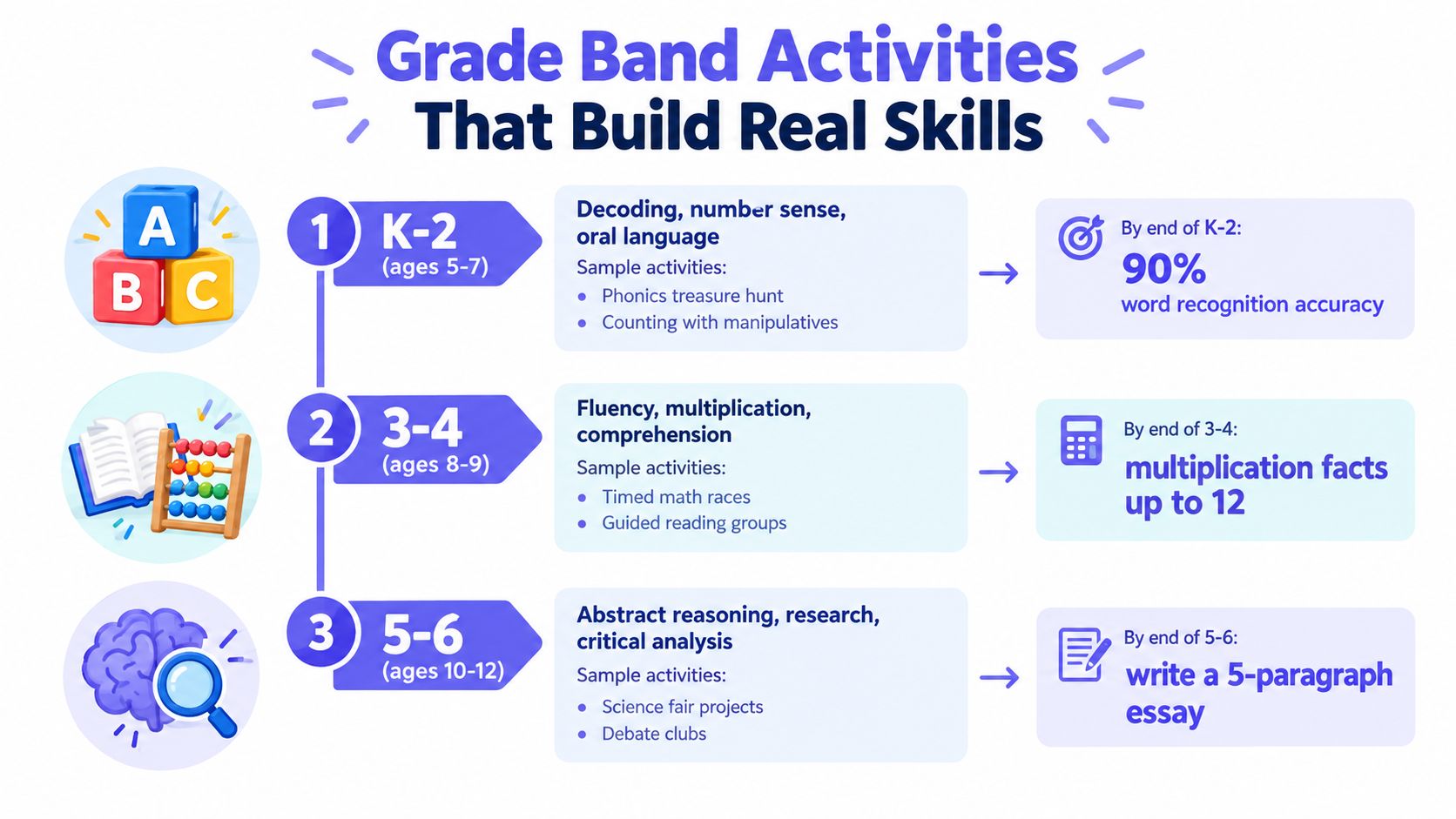
- Kindergarten through grade 2: children are building the machinery of learning. They crack the code of print, hear sounds in words, count with meaning, and learn classroom routines.
- Grades 3 and 4: children start using those basics to handle more text, more steps, and more written explanation.
- Grades 5 and 6: children are expected to reason, compare sources, justify answers, and manage more independent work.
Practical rule: If a child can't do the hidden prerequisite, the visible assignment won't tell you much.
A worksheet may look "easy" to an adult and still be very hard for a child who hasn't automated the earlier skill. A grade 4 math page on area, for example, can fall apart because the child still counts one by one and doesn't trust multiplication.
What children are really building
By the end of this span, strong K 6 learning usually means the child can do work like this:
- Read with purpose: not just say the words, but explain what a paragraph means.
- Handle number relationships: not just memorize steps, but see why operations work.
- Observe and explain: in science, children should notice patterns, sort evidence, and describe what happened.
- Work with others: listen, wait, revise, and recover from mistakes.
If you want a concrete starting point for younger learners, curated tools for kindergarten can help families see what early classroom expectations look like. Used well, resources like that don't replace teaching. They make the early targets more visible.
Core Learning Objectives From Kindergarten Through Grade 6
The mistake adults make is treating objectives like a shopping list. Learn letters. Learn counting. Learn fractions. Learn paragraphs. Real K 6 learning doesn't work that way. Each domain stacks on top of the last one.
Four domains that keep compounding
Children in K 6 are growing across four core areas: literacy, numeracy, science, and social-emotional development. If one area stalls, the others usually feel it too.
A simple developmental guide such as Ocodile child development stages can help parents match expectations to readiness, especially when a child seems uneven. That unevenness is normal. Strong verbal students can still struggle with written output. Confident readers can still avoid math explanation.
K-6 Learning Objectives by Domain and Grade Band
| Grade Band | Literacy | Numeracy | Science | Social-Emotional |
|---|---|---|---|---|
| K-2 | Hear sounds, connect sounds to letters, decode simple text, retell a story orally | Count with meaning, compare quantities, understand place value beginnings, add and subtract within concrete contexts | Observe, sort, describe, ask simple questions | Follow routines, take turns, name feelings, persist through short challenge |
| 3-4 | Build fluency, answer questions from text, write clear sentences and short paragraphs | Use place value fluently, solve multi-step problems, build multiplication and division understanding | Record observations, compare results, classify by features | Work in pairs, explain thinking, accept correction, organize materials |
| 5-6 | Read longer texts, compare ideas, cite evidence, write organized explanations and arguments | Work with fractions, ratios, early algebraic thinking, explain method choices | Plan simple investigations, use data, identify patterns and limits | Manage deadlines, collaborate in groups, revise work, self-assess honestly |
The inflection points adults should watch
The biggest literacy shift comes when children move from learning to read toward reading to learn. If decoding still takes all their energy, comprehension suffers because too much mental effort is going to the words themselves.
Math has a similar turning point. Early arithmetic is about counting, combining, and basic fact patterns. Later elementary math expects children to notice structure. That is where many students who seemed "fine" hit trouble.
A child can finish every page and still miss the pattern that the page was meant to teach.
Science also gets misread. In the early years, science is not mainly about memorizing facts. It is about noticing, predicting, testing, and explaining. By grade 6, a student should be able to track a question across several steps rather than report one isolated observation.
Social-emotional learning matters because independence is not a personality trait. It is a taught school skill. Waiting your turn, listening closely, repairing mistakes, and asking for help at the right moment all support academic growth.
Common Curricula and Teaching Methods in K 6
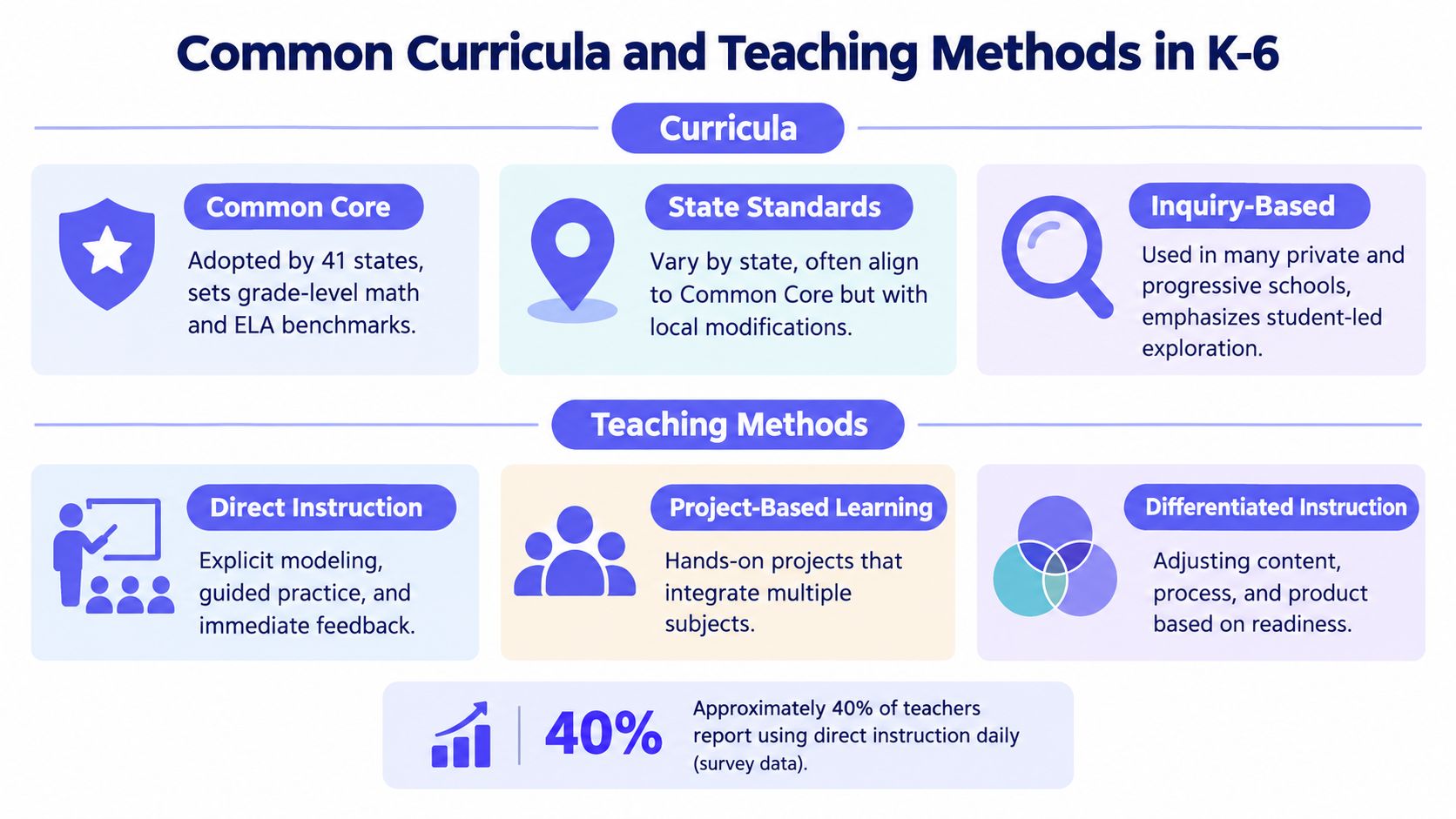
Parents hear a lot of labels. Common Core. state standards. inquiry-based. project-based. balanced literacy. direct instruction. Montessori-inspired. Most of the confusion comes from mixing up curriculum goals with teaching methods.
A curriculum tells a school what children should learn. A teaching method tells the teacher how to get them there.
What curriculum frameworks are trying to do
Some frameworks prioritize shared grade-level expectations. They aim for consistency. Families usually like this because they can see clearer benchmarks from year to year.
Others give schools more local flexibility. These can work well when teachers are strong at sequencing content and checking for gaps. They can also drift if the school is loose about what mastery looks like.
A third group leans heavily into inquiry. This can deepen thinking, but only when children have enough background knowledge and enough explicit instruction to work productively. Inquiry without foundations often turns into guesswork.
What common teaching methods optimize for
Here is the plain version I use with families:
- Direct instruction: best when a skill is new, precise, or easy to misunderstand. Think phonics, place value, and standard written methods.
- Guided practice: best when children need coaching in a small group before they can work alone.
- Project-based learning: useful when students already have enough basics to apply skills across subjects.
- Differentiated instruction: necessary in every real classroom because children rarely arrive with the same readiness.
No single method is "best" all the time. Good teachers switch methods based on the task in front of them.
What parents should ask the school
Parents don't need jargon. They need clear questions.
- Ask about sequence: What comes first, and what must be secure before the next unit?
- Ask about intervention: What happens when a child doesn't grasp the core idea?
- Ask about proof: How does the teacher know the child can do the work independently?
If you're building a software product for schools or families, the same clarity matters in launch messaging. A concise visual explainer often beats a long feature tour, which is why founder-led teams often study examples like how to make promotional videos before launch.
Why Completion Is Not the Same as Mastery
Primary education is one of the biggest social expansions in modern history. Global primary enrollment grew from about 2.3 million children in the early 19th century to more than 700 million today, and nearly 90% of the world's school-age children are now in primary school according to Brookings' summary of long-run global education data. That is real progress.
But enrollment and completion don't tell you whether children learned enough.
The gap most adults miss
Global reporting on foundational learning shows the harder truth. Only 58% of students reach minimum reading proficiency and only 44% reach minimum math proficiency by the end of primary school, even though primary completion has risen to 88% according to the UNESCO GEM Report summary.
That gap is the under-discussed metric in K 6 learning. A child can complete primary school and still not read or calculate at the level the next stage expects.
Completion Metrics vs Mastery Evidence in K-6
| Metric Tracked | What It Shows | What It Misses | Mastery Signal to Look For |
|---|---|---|---|
| Attendance | The child is present | Whether the child understands the lesson | Can the child explain the idea without prompts? |
| Report card pass mark | The child met classroom requirements | How much support, reteaching, or guessing was involved | Can the child do a fresh task independently? |
| Grade promotion | The child moved on | Whether gaps were carried forward | Does the child handle next-grade work without collapse? |
| Finished assignments | The child complied with workload | Whether the thinking was deep or copied | Can the child transfer the skill to a new context? |
Children don't need more years in school alone. They need enough learning in those years to stand on.
Here is the classroom version. A grade 3 student reads aloud smoothly enough to sound competent, passes spelling tests, and earns decent marks for effort. Then the class starts reading informational texts and answering written questions. The child can pronounce the words but can't explain the paragraph. Completion looked fine. Mastery was not there.
That is why I push parents and school leaders to watch independent performance on unfamiliar tasks. In K 6 learning, that tells the truth faster than almost anything else.
Grade Band Activities That Build Real Skills
The best activities don't just keep children busy. They target a specific bottleneck. If you know the bottleneck, you can choose better tasks at home and in class.
Kindergarten through grade 2
At this stage, children need repetition, talk, movement, and very clear feedback. Abstract explanation is less useful than direct modeling.
Try a few activities like these:
- Syllable sorting game: say words aloud and sort them by beats. This strengthens sound awareness, which supports early reading. At home, use family names or food labels.
- Counting collection: gather buttons, blocks, or dry pasta and ask the child to count, group, and explain how they know. This builds quantity sense instead of shallow reciting.
- Five-minute retell: after a read-aloud, ask the child to tell what happened first, next, and last. This supports sequencing, oral language, and comprehension.
A lot of early struggle comes from speeded adult expectations. Children need time to say the sound, move the object, and tell the thought.
Grades 3 and 4
School starts asking for more explanation. Many children can still "do school" while dodging the deeper work. Don't let that happen.
Use tasks that force thinking into language:
- Paragraph claim exercise: give a short article and ask, "What is the main point? What sentence proves it?" This grows comprehension and evidence use.
- Kitchen measurement problems: double a recipe or halve one. This gives math a real context and makes children explain steps.
- Classification project: sort local rocks, leaves, or insects by features and justify the groups. That develops observation and scientific reasoning.
If you need fresh classroom ideas, collections focused on STEM fun for 2025 classrooms can spark projects that stay hands-on without losing academic purpose.
Grades 5 and 6
Older elementary students need opportunities to gather evidence, weigh it, and present a position. They are old enough to handle more independence, but they still need structure.
Good fits include:
- Policy debate: ask students whether a school rule should change. Require evidence and a rebuttal. This builds argument and listening.
- Survey and chart project: students write questions, collect responses, and present the results. This supports data handling and interpretation.
- Short documentary-style presentation: students research a topic and present it orally with visuals and cited facts. This strengthens planning and synthesis.
A short montage can also help teachers show process work or student project themes to families, especially if they need simple visual storytelling ideas like those in a video montage maker guide.
Tools and Resources for Parents and Educators
Most families search for one magic resource. There isn't one. The best support stack is usually modest and consistent. One tool for practice, one reading routine, one adult who notices errors and names them clearly.
Four categories that actually help
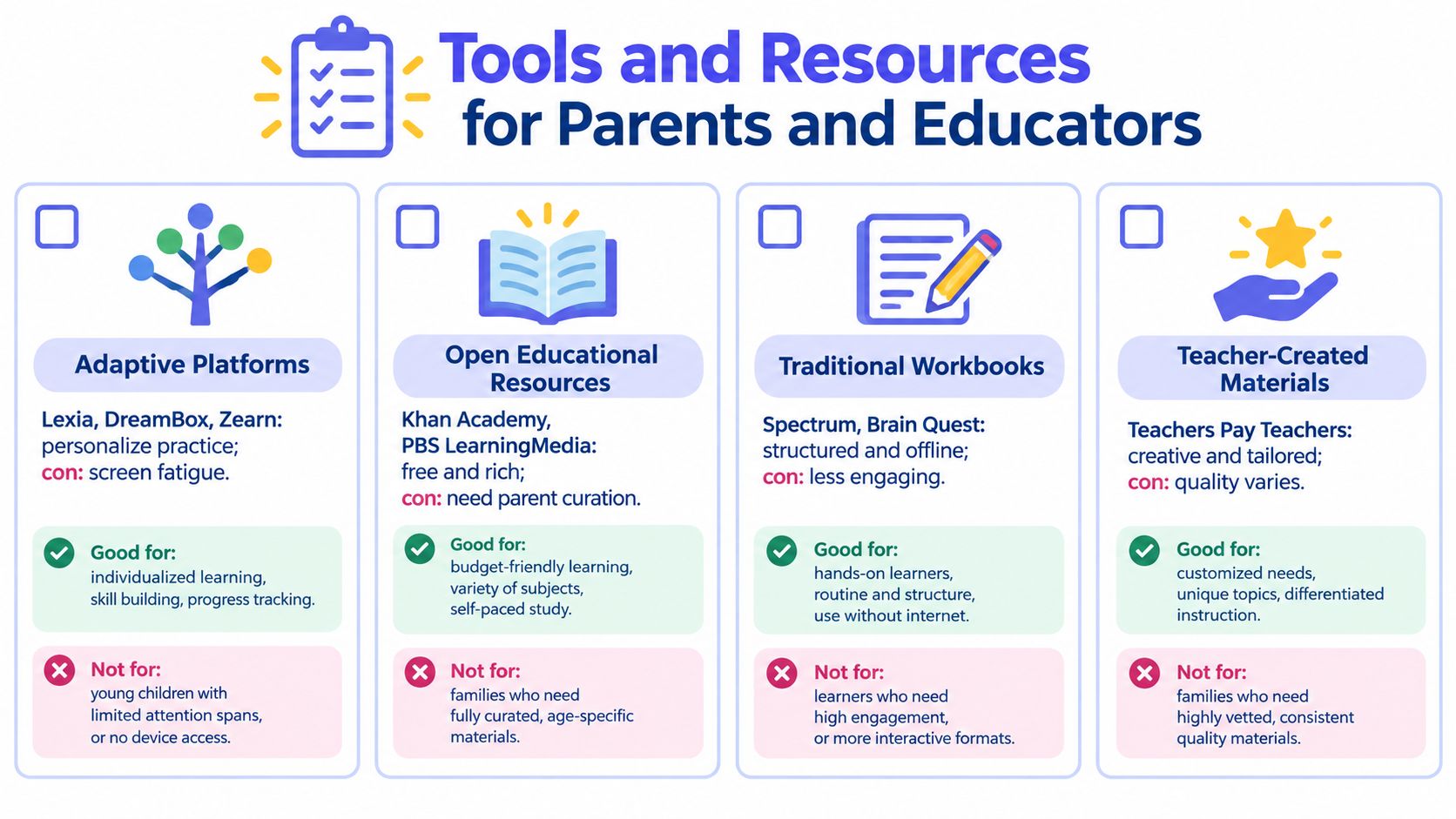
- Adaptive practice platforms: These can adjust the next task based on a student's performance. They work best for extra practice after teaching, not as the whole program.
- Open educational resources: Useful when parents need explanations, read-aloud material, or extension tasks. The tradeoff is curation. Someone still has to choose what matches the child's level.
- Assessment tools: These matter because adults are often poor judges of hidden gaps. A child may seem fluent until a task requires transfer.
- Routines and printables: Often underrated. A steady reading slot, a weekly writing check, and a visible skill list can do more than a pile of random activities.
What each resource type does badly
People waste time. Adaptive practice can become passive clicking. Open resources can become scattered. Assessments can become labels instead of action. Printables can become busywork.
The fix is simple. Pair every resource with a narrow purpose.
- For reading: use it to check decoding, fluency, or comprehension, not all three at once.
- For math: decide whether the issue is facts, procedure, language, or reasoning.
- For writing: look at one or two targets first, such as complete sentences or supporting details.
The strongest resource in K 6 learning is still an adult who reads the child's work carefully and responds to the actual error.
If you're a founder building an education product, that same discipline applies to your launch page. Show one use case clearly, then one proof point, then one action. A concise product teaser format like AI teaser video maker is useful because it pushes that kind of focus.
How to Tell if K 6 Learning Is Actually Working
Attendance is not proof. Grade promotion is not proof. Even a neat homework folder is not proof. In K 6 learning, the question is whether the child can transfer the skill.
Three checks you can run quickly
Parents can learn a lot in under ten minutes.
- Cold reading sample: hand the child a grade-level passage they haven't practiced. Listen for accuracy, pace, and whether they can explain what it meant.
- Multi-step word problem: give one problem and don't hint. Watch where the breakdown happens. Is it reading the problem, choosing an operation, or persisting?
- Child-led explanation: ask, "Teach me what you learned about fractions," or any recent topic. If the explanation is vague, the understanding often is too.
Red flags worth taking seriously
A child may need more than "try harder" if you see patterns like these:
- Reading sounds smooth, but meaning is weak
- Math answers appear, but the child can't explain the steps
- Writing is much shorter or simpler than oral answers
- Work collapses when the format changes even slightly
Teachers should pair quick formative checks with student self-assessment. Children often know where they feel lost before adults do. The key is to ask specific questions rather than broad ones.
When families need to communicate progress clearly to others, structure helps. The same is true in product storytelling. A sharp opening hook, for example, often decides whether anyone keeps watching, which is why pieces like three-second hook guidance are useful beyond marketing.
FAQ on K 6 Learning
What does K 6 learning mean
K 6 learning means the structured years from kindergarten through sixth grade, when children build the foundation for reading, writing, math, science thinking, and independent learning. The main point is not exposure to many topics. The main point is securing the skills that later grades will assume are already in place.
Why do grade bands matter so much in K 6 learning
Grade bands matter because children do not develop in one smooth line. Early elementary students need explicit instruction and repetition, middle elementary students need guided application, and upper elementary students need more reasoning and independence. If adults skip that progression, children may appear busy without building durable skill.
What curriculum is most common in K 6 classrooms
The most common setup is some form of state-aligned grade-level curriculum paired with a mix of direct teaching, guided practice, and independent work. Parents shouldn't get stuck on labels alone. The better question is whether the school teaches prerequisite skills clearly, checks for understanding often, and intervenes when a child stalls.
Why are social-emotional skills part of academic learning
Social-emotional skills belong in academic learning because children use them every day to listen, persist, revise, collaborate, and recover from errors. A child who gives up quickly or can't manage frustration will struggle academically even with good raw ability. In elementary school, self-management is part of school readiness, not an optional extra.
When should a parent ask for extra help or a specialist
A parent should ask for extra help when a problem persists across weeks, shows up in more than one setting, or blocks access to daily classwork. The signal isn't one bad quiz. The signal is a pattern, such as weak decoding, extreme avoidance, inability to explain thinking, or progress that depends entirely on adult prompting.
If you're an early-stage founder building a product for families, teachers, or schools, your launch message needs the same clarity good K 6 teaching needs. "ShipTeaser" lets you paste a product URL and get a 15-second, 1080p, silent motion-graphics teaser in about 2 minutes, built in five scenes: hook, problem, solution, proof, CTA. "ShipTeaser" supports 16:9, 1:1, and 9:16, the first video is free with no credit card, and paid plans are $99 per month for 1 video per week, $149 per month for 2, and $199 per month for 4. See ShipTeaser if you want a fast way to show what your software does without turning launch week into a video production project.