Most guides to AI in marketing open with a shopping decision: which tool, which subscription, which stack. That's the least useful question, and it's the one most likely to burn your first month. The order that holds up is tasks first, review second, measurement third.
AI helps marketing most when it takes on bounded work such as research, idea generation, first drafts and assembly of an asset from material you already own, with a person approving every claim before it reaches an audience. That division of labor is what separates a workflow from a content factory, and one controlled test is what proves the output deserved publishing. Teams getting real value from AI in marketing aren't the ones producing the most, they're the ones with a review step and a measurement habit.
Where AI Fits in a Marketing Workflow
Integration is now the bottleneck, not adoption. In a 2024 global survey of 4,850 marketing decision-makers across North America, Latin America, Asia-Pacific and Europe, Salesforce found that 75% were experimenting with AI or had fully implemented it in their operations (Salesforce). Among marketers using AI, generative AI was more commonly used than predictive AI. Respondents also reported difficulty unifying customer data sources, a gap that affects personalization, segmentation and attribution. Salesforce found that high-performing teams were more likely than underperformers to have integrated AI into their operations.
Usage clusters where mistakes are cheap. Marketer AI use concentrates at the front of the funnel, with research and ideation among the leading applications, according to the daily-AI survey reported by Business Insider. A weak research summary or headline can be corrected in a draft. A public error may require a correction and damage trust.
For a small team, start with work that is reversible and keep AI away from anything that becomes a public promise. A testimonial needs a real source. A price must be current. A performance number needs evidence the team can defend. Automation does not make those checks less important.
The sorting rule: if a wrong output would require a public correction, either a person writes it or a person reads it line by line.
| Marketing task | AI's role | Human check | Risk level |
|---|---|---|---|
| Audience and competitor research | Summarize reviews, pages and customer questions | Verify each insight against sources | Low |
| Idea generation | Produce hooks, headlines and CTA options | Choose and edit the strongest few | Low |
| Short launch video from a product page | Turn the page into a silent launch teaser | Review the video and every claim before posting | Medium |
| Paid ad copy variants | Draft variants for testing | Check pricing, claims and platform rules | Medium |
| Testimonials or performance claims | Do not generate proof that does not exist | Publish only evidence from real customers | High |
A solo builder preparing a launch page can ask a tool for headline options based on her own copy, select the strongest, then check each against the page before using it. AI supplies options; the marketer supplies judgement. An automated send carries a different risk from a saved draft, so read about keeping humans on high-risk sends before removing an approval step.
Before opening a tool, list your last five marketing tasks and mark each low, medium or high risk. Start with the low-risk tasks, where mistakes are easy to catch and reverse.
Choose Tools by Task, Not by Hype
A tool earns a place in your marketing workflow when its output, inputs and review process fit the task. Judge those before comparing features or pricing. A short checklist makes the trade-offs visible.
- Output: Check whether the tool makes text, images or video, and whether the format and length suit the channel. Predictable outputs are easier to review and schedule.
- Inputs: Find out whether it needs a URL, a brief, a data file or only a prompt. Using material you already have can reduce guesswork, but the source still needs to be accurate and current.
- Review: Confirm you can inspect the complete output and revise it before anything is published. Preview and approval steps help keep errors out of public channels.
- File access: Check whether you can export and keep the work. If you lose your assets when you cancel, the subscription controls access to the deliverables.
Look for practical red flags, too. If there is no way to revise an output, a mismatch may require starting again. If the tool cannot explain how it handles your content, do not submit sensitive client material. Treat performance claims cautiously when no method is given to support them.
Video can merit a place on the shortlist, but format-level popularity does not prove a specific asset will work for your audience. In its 2025 benchmarks, 58% of B2B marketers named video as the content type producing the best results, ahead of case studies and customer stories at 53%. The same Content Marketing Institute data reports that 76% used video and 61% expected their organizations to increase investment. Use those figures as context, not as a reason to publish without review.
For launch content, ShipTeaser reads a public product page and makes a 30-second video in 1080p, built for silent feeds and ending with your own call to action. It reads the page copy word for word, along with its colours, type, logo and screens; a short brief and natural-language revisions can steer the result. The finished video uses five beat-cut scenes: hook, problem, solution, proof and call to action. Review every scene for factual errors or a misread of the brand before publishing. Its silent motion-graphics format suits product launches, not performance ads built around actors or hook variants.
Use a shortlist of two tools, then ask three practical questions: can it use the material you already have, can you inspect and revise the full output before it goes live, and can you export the finished file? For other categories to consider when assembling a stack, browse these SaaS marketing tools. Compare tools against the actual task, not a feature checklist detached from your workflow.
How to Run One AI Workflow From Brief to Publish
A repeatable AI workflow needs a clear outcome, a reliable source, and a human approval point. Run it once to test an asset; repeat it weekly to establish a publishing cadence.
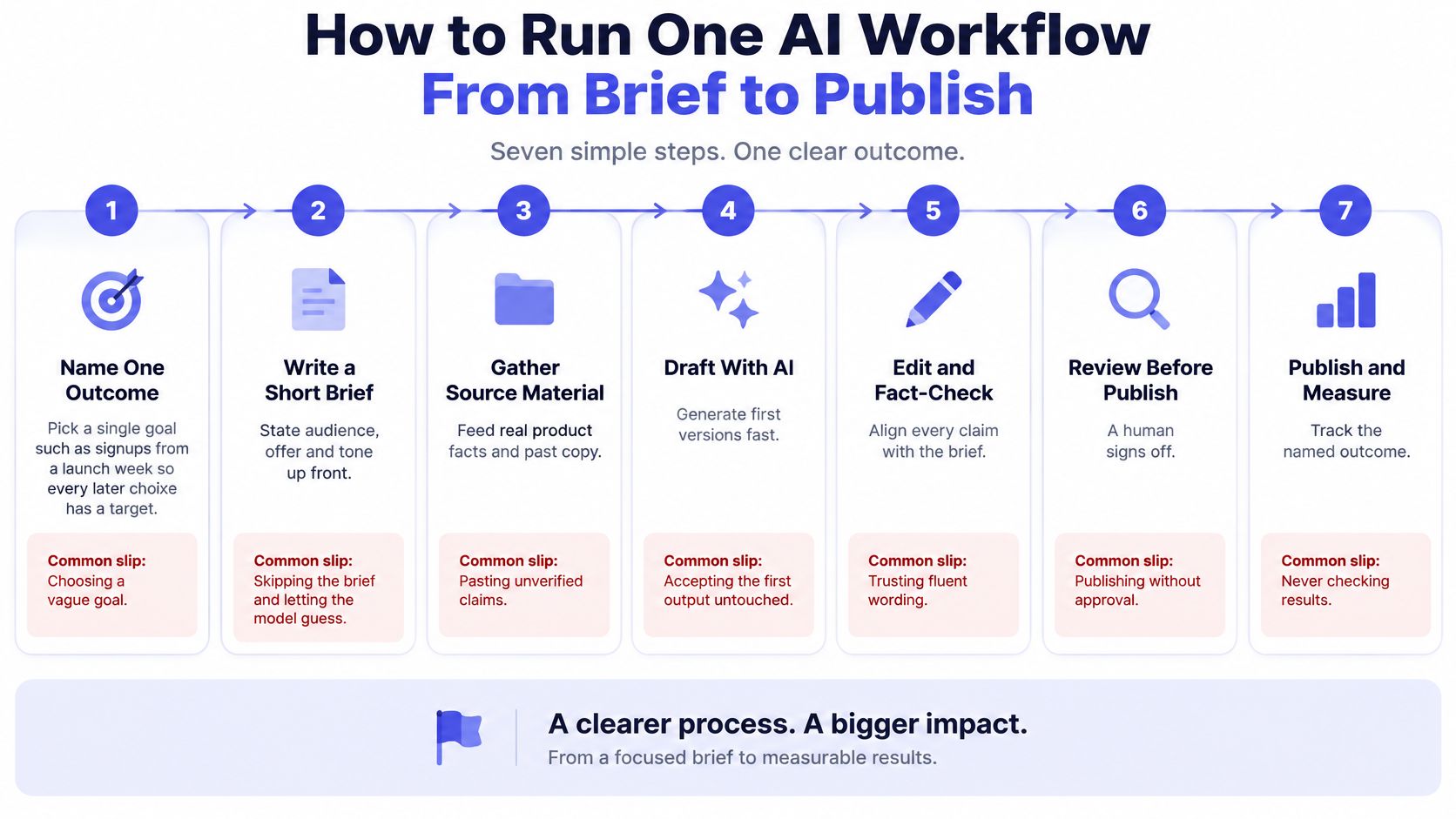
1. Name one outcome. Choose signups from launch week, activated accounts, or qualified demo requests. Write down the result you want, then judge each later decision against it. “Awareness” is too vague to show whether a video worked.
2. Write a short brief. Specify the audience, one problem, one proof point, and one call to action. The proof point gives the teaser something concrete to communicate. In CMI 2025 research, 92% of B2B marketers used short articles or posts, but rated them 43% for effectiveness; case studies and customer stories ranked second at 53%. A vague brief tends to produce copy that could belong to any competitor.
3. Choose the source of truth. For a launch video, use a public product page, landing page, or app site. ShipTeaser reads the page's copy word for word, along with its colours, type, logo, and screens. Context you supply can enrich that extraction, but a weak or outdated page still limits the result. Fix the source before generating.
4. Generate focused variants. Create five takes on the same video, each with a different opening line or first frame, not five different videos. Change one element at a time so the results remain useful to compare. For video work that needs a distinct channel and format plan, use this guide to short-form video strategy for brands.
5. Steer with concise revisions. A short brief and natural-language instructions can shape the result. For example: “Tighten the problem line to one sentence.” Revise when the underlying structure works; regenerate when it does not. That keeps useful parts of the draft while making the requested change clear.
6. Hold the draft for approval. Keep publishing separate from generation. A named reviewer should read the script and watch the rendered file before it goes live. Generated videos can contain factual errors or misread the brand, so every video needs review.
7. Publish with a tagged link. Use a variant ID or UTM parameters to connect signups with the asset that drove them. Without a tag, the result can disappear into campaign-level reporting.
Keep the operating sequence simple: outcome, brief, source, variants, approval, tag. The same source material can support a steady stream of assets; this guide to automated content generation explains that broader workflow. If a walkthrough is easier to follow, the video below covers the steps.
Review Every AI Output Before It Goes Live
A polished video can still make a false claim. AI-generated marketing content often sounds confident, and a clean render with the right logo can look ready before anyone checks what it says. Review is part of production, not a final formality.
Use this checklist before publishing:
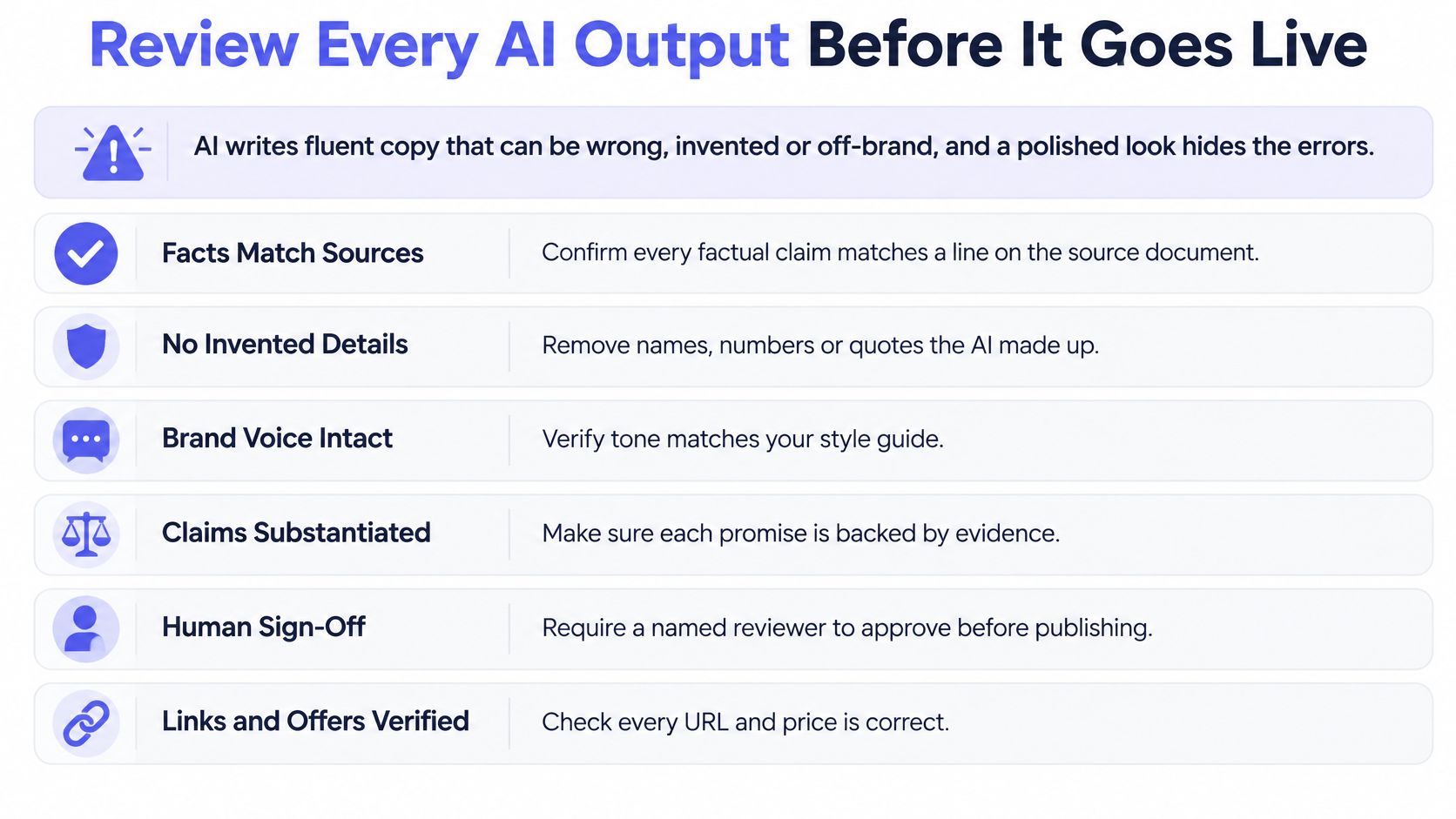
- Every factual claim matches the source page. Open the page and confirm the wording supports each claim.
- Numbers, testimonials and performance promises are supported. Remove claims the source does not substantiate, such as “40% faster” when that figure is absent.
- Pricing is current. Check it against the live page, since saved content can become stale.
- Logo, colors and type match the brand. Compare the actual assets and styling rather than relying on a general impression.
- Supplied media is licensed. Confirm that music and images allow commercial use.
- One named person approves the final asset. Assign approval to an individual so responsibility is clear.
The U.S. National Institute of Standards and Technology published its voluntary AI Risk Management Framework on January 26, 2023, and released a Generative AI Profile, NIST-AI-600-1, on July 26, 2024, to address risks specific to generative systems (NIST). Its framework calls for generative outputs to be designed, evaluated and monitored for trustworthiness before distribution. For marketing teams, that means a human must check the claims and brand fit before content goes live. Generated videos may contain factual errors or misread the brand, so each one needs review.
Approval by impression is a common failure. A reviewer watches once, sees smooth motion and a correctly placed logo, then misses a claim that the product “cuts onboarding in half.” Check the video against the source copy, and compare its visual choices with your brand guidelines. This guide to creating an on-brand video without a designer covers the visual consistency side; a person still needs to verify what the video says.
The 90-second test: Point to each claim in the video and identify the line on the source page that supports it. If no line supports it, remove the claim.
Measure Results With One Controlled Test
More AI output does not prove better marketing. A workflow can cut production time and still produce assets that attract the wrong visitors or fail to convert. Separate efficiency, such as hours per asset and editing cost, from effectiveness, such as click-through rate, landing-page conversion and cost per qualified action. The first measures production. The second measures whether the work achieved its purpose.
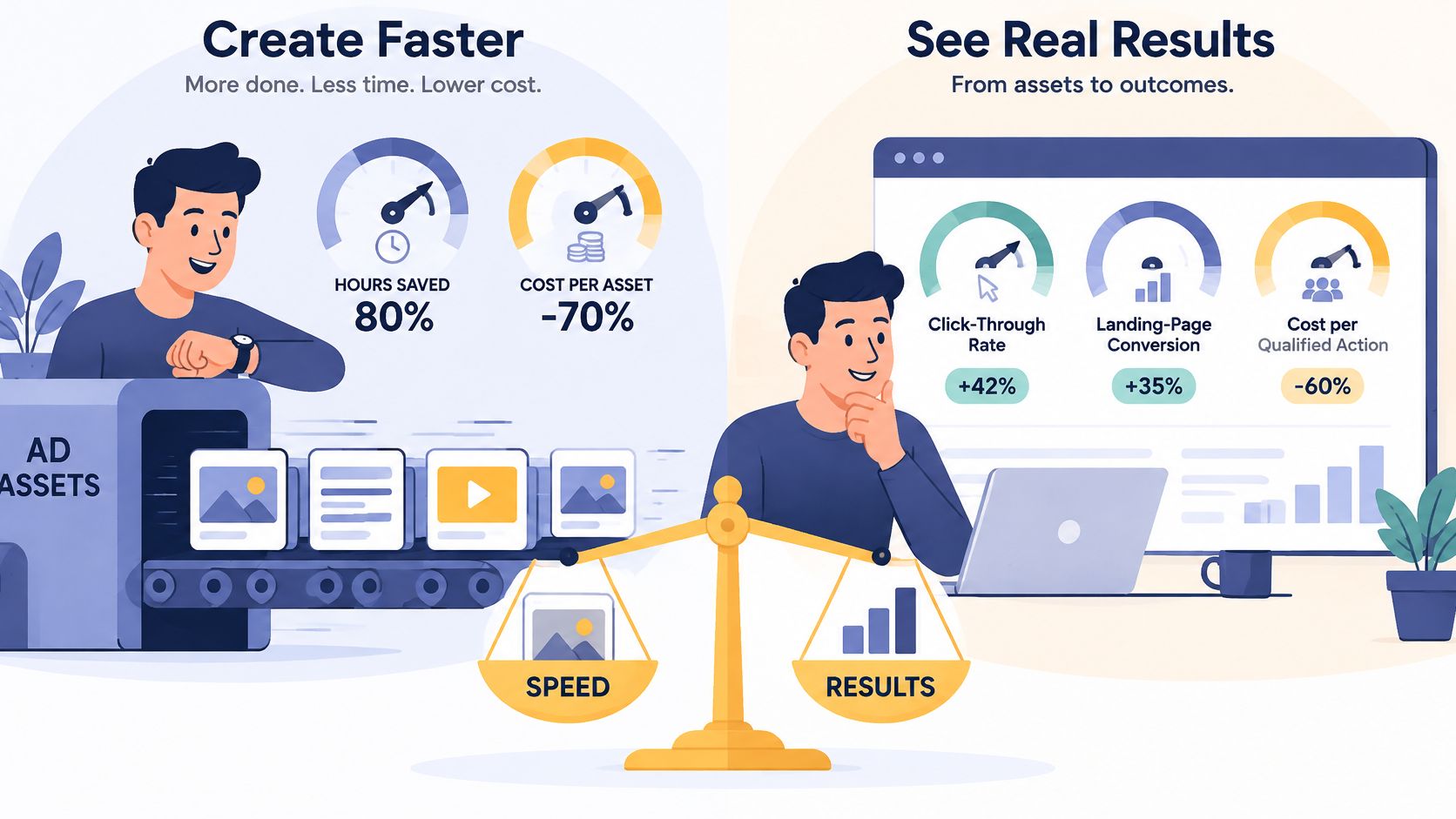
Efficiency Is Easy to Measure and Proves Little
Faster production is useful when it gives a team more time to test a message. But shipping more assets without tracking conversion only creates more output, not evidence that marketing improved. Measure efficiency alongside outcomes, and do not treat hours saved as a substitute for business results.
A survey of 184 marketing professionals found that only 6.5% measured AI ROI against defined benchmarks, while 65.1% either did not measure it or were unsure whether it was measured, according to growth experimentation statistics. The same source reports that structured experimentation is associated with 15% to 30% conversion-rate lifts and 40% to 60% faster decisions. A separate survey reported that the share of marketers able to prove AI ROI fell from 49% to 41% as leadership expectations shifted from productivity toward measurable business results (GlobeNewswire).
Record the same metrics for every variant and the control. This makes it possible to distinguish lower production effort from stronger campaign performance.
| Metric type | Metric | What it tells you |
|---|---|---|
| Efficiency | Hours per asset and editing cost | Shows production savings, not business impact |
| Effectiveness | Click-through rate | Shows whether the message earns attention |
| Effectiveness | Landing-page conversion | Shows whether visitors take the intended next step |
| Effectiveness | Cost per qualified action | Compares variants and control against the same goal |
| Quality | Activation or retention after a set period | Shows whether the audience reached was the right one |
Run One Controlled Test This Month
Use one landing page and one decision. Choose a single conversion event, such as a signup or an activated account. “Engagement” is too vague unless the team defines exactly what counts and can measure it consistently.
- Choose one conversion event. Make it countable by someone who did not run the campaign.
- Keep a control asset. Use the previous launch video or a static page section. Without a control, you cannot separate the effect of the asset from changes in the market.
- Hold audience, placement and budget constant, then split traffic at random. Change one element at a time. For example, test a different opening line while keeping the call to action unchanged.
- Tag every variant with its ID, source URL, audience, placement and spend. Without those details, results cannot be traced back to a specific asset.
- Set the review date and minimum number of qualified signups before launch. Decide in advance when to assess results so an early fluctuation does not become a premature winner.
- Check claims and brand fit before publication. A strong result does not make an unsupported claim acceptable.
Suppose two teaser variants reach the same audience from the same page. Variant A earns more clicks but fewer signups. Variant B earns fewer clicks and more signups. If signups are the chosen conversion event, B is the stronger result. The click data still helps diagnose the opening message, but it does not override the goal.
What Low Traffic Does to Your Test
At low traffic, small differences can reflect normal variation rather than a meaningful change. Look at the direction and size of the result, not a two-signup gap in isolation, and give a test weeks rather than days before judging it. Set the review point and decision criteria before launch; otherwise, it is easy to stop when a result looks promising or keep testing until the preferred version appears to win.
For channel-level comparisons, the ROI measurement guide for e-commerce founders explains how to assess cost against revenue. If the campaign supports a launch, use these product launch metrics to connect the video to the page's outcomes.
ShipTeaser can generate launch videos from a public product page, but it is built for launch content rather than performance ad creative. Its videos use a fixed five-scene structure: hook, problem, solution, proof and call to action. That structure can help keep the format consistent while testing a message, but it does not replace a control, a defined conversion event or a human review.
Choose the landing page and define the control before generating variants. Without a baseline, there is no reliable way to tell whether the new asset improved the result.
FAQ
Do I have to disclose AI use in marketing?
Check the rules that apply to your market and channel, then make disclosure clear when it is appropriate. Cint reports that 74% of U.S. consumers believe brands and creators should disclose AI use in advertising, while 44% say discovering undisclosed AI-generated advertising would reduce their trust (Cint). A neutral caption such as “AI-assisted production” can explain the process without making the label the focus.
What if the AI invents a claim?
Remove it and check the source page for what the evidence supports. Keep approved claims with their source wording in a shared claim library, along with phrasings the team must avoid. This gives reviewers a consistent reference when generated copy needs correction.
How long before I know whether AI content works?
Set a review date and define which qualified actions matter before publishing. Judge the output against the test conditions and available evidence, not a fixed number of days. If the result is inconclusive, keep the conclusion limited rather than treating a small change as proof.
Can one person run this without a team?
Yes, if the workflow keeps a written record of the approved claims, control asset and results. One person can generate and review low- or medium-risk content, but should not treat a plausible draft as verified. For ShipTeaser videos, review every output before publishing because generated videos may misstate facts or misread the brand.
ShipTeaser reads a public product page and renders a 30-second, 1080p video designed for silent feeds, ending with your call to action. It can help turn a launch page into an asset to review, but the video still needs your approval before it goes live. Paste your landing page into ShipTeaser and review the finished video before publishing.