You shipped a landing page last Tuesday. A few founders you respect asked what changed, and a half-finished changelog is still sitting in a doc. That is the week founders either post a victory lap or go quiet until launch day.
Building in public means sharing real progress, decisions, numbers, and setbacks while the product is still being built, not saving the reveal for launch day. Treat it as a measured distribution experiment with a disclosure rulebook: publish the decision and the evidence, protect customers and systems, and judge the work by activated accounts rather than likes. Public posting is an experiment, not a guaranteed growth channel.
What Building in Public Means and Where It Started
A launch announcement is a single reveal. Building in public is a running log the audience can read from the first week, including the weeks when the numbers are weak.
The clearest early example is Baremetrics. Josh Pigford founded the subscription-analytics company in 2013, built the first version in seven working days, and published recurring revenue, customer churn, and lifetime value. By April 2014, Baremetrics had reached approximately $10,000 in monthly recurring revenue, about $120,000 in annualized subscription revenue, according to the Economic Times account of Pigford's early company.

From casual notes to a standing habit
Baremetrics became tied to the Open Startup Initiative, the practice of publishing metrics most companies keep internal, including revenue and growth. That move changed the shape of the idea. Informal founder updates can stop the week the graph looks ugly. A structured operating habit keeps product work, customer feedback, marketing, and financial reporting visible on a schedule.
Think of an open kitchen. Customers watch the cooking, so they trust the meal before they order. Public metrics do the same job. They hold you to a number you already defined, and they give strangers a reason to believe the product is real.
Label the claim: A founder-reported milestone is a strong story. It is not proof that transparency caused the revenue.
The $10,000 MRR figure was Pigford's reported milestone, not the output of a controlled study. Copy the habit of showing your work. Don't copy the month and expect the same result.
The test I would use before you start is audience fit. If your buyers already follow founders and makers online, a public build log meets people who expect unfinished work. If they don't, you will mostly collect peer applause.
What to Share and What to Keep Private
Share the decision and the evidence behind it. Keep anything that exposes a customer, a system, an unfinished deal, or your own health.
The table is the sorting tool. Each row is one rule you can apply in seconds, before you paste a draft.
| Disclosure | Share publicly | Keep private | Rule |
|---|---|---|---|
| Shipped features and changelog | Yes, with dates | Unreleased roadmap items with no date | Show finished work only |
| Experiment hypotheses and results | Yes, with the metric definition | Exact playbook still producing results | Publish the result, hold the tactic until it stops working |
| Revenue and MRR | Yes, with definition and period | Bank details and individual invoices | State the definition, period, refunds and fees |
| Customer names and stories | Only with written permission | Anything identifiable without consent | Ask first or anonymize |
| Security and infrastructure | No, until the fix ships | Credentials, architecture and open vulnerabilities | Disclose after the fix |
| Founder workload and wellbeing | Summarized only | Daily stress and personal health details | Keep to a fixed weekly time budget |
How the rows work in practice
Shipped features are safe once they have a date, because a reader can check that the thing exists. Experiment results are safe once you publish the metric definition, so nobody has to guess what "conversion" meant that week. Revenue is safe only when you state the MRR definition, the time window, refunds, and fees. A screenshot with no denominator is a mood, not a report.
Customer names need written permission, or you anonymize the story until the person can't be recognized. Security details wait until the fix ships. Publishing an open hole, a credential path, or your architecture is a gift to anyone scraping your posts.
Acquisition playbooks stay private while they still work. The moment you publish a tactic that is still producing signups, copies show up and the edge thins. Publish the result. Hold the recipe until it stops paying.
Minimum viable transparency
Minimum viable transparency is four things in public: the problem, the experiment design, the anonymized learning, and the finished teaser. Personal data, private customer feedback, vulnerabilities, and sensitive finances stay out of every post.
A beta launch announcement still has to pass that filter. Name the test. Leave identities out.
If a disclosure would hurt a customer, a system, or your own recovery when someone copies it, it stays private.
Metrics That Show Whether Public Building Works
Measure a funnel, not a follower count. A follower can like a post and never become a customer. Each row below moves one step closer to an activated account.
| Metric | What It Tells You | How to Track It |
|---|---|---|
| Qualified profile visits | Whether people who fit your buyer profile are looking | Platform analytics, reviewed weekly |
| Landing-page sessions with campaign tags | Which post sent traffic | A unique UTM parameter for each post |
| Teaser plays and completion rate | Whether the opening holds attention | Video platform analytics for each upload |
| Click-through rate | Whether interest turns into a click | Link tracking on each post |
| Signups per post | Whether the post drives acquisition | Signup source field in your product |
| Activated accounts per post | Whether signups reach a first real action | Product activation event in your analytics |
Tag every post with its own campaign parameter. A landing-page session should trace back to the exact post that sent it. Without that tag, you will credit "social" and learn nothing.
Compare narratives, not vibes
Run two narrative types in the same window and the same denominator. One week, publish a finished teaser. The next, publish a technical or customer-learning note. Don't change the signup definition halfway through, and don't drop the quiet week from the average.
There is no published standard for most of these rates that you should borrow from another founder. Compare each post with your own last four weeks.
Watch the break between attention and buyers. If qualified profile visits rise and activated accounts stay flat, the audience is attentive and may not be your buyer. Brand monitoring tools and practical examples help you see who repeats the post, which is a different question from who clicks it.
Keep the narrative type that produces activated accounts. Drop the one that only produces likes. Read those counts next to your product launch metrics so activation means the same event every week.
Benefits and Trade-offs With Real Results
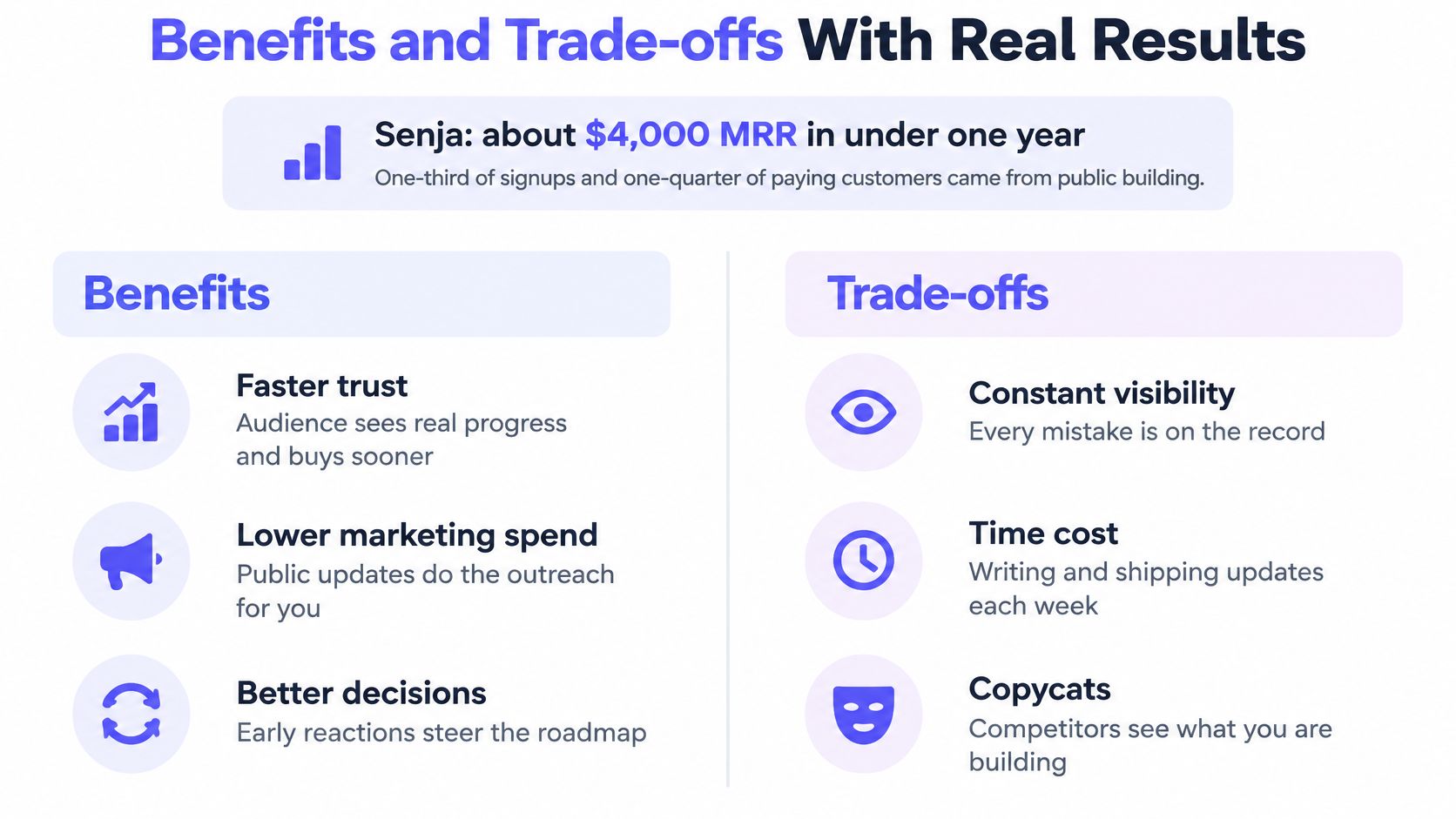
A 2023 Startup Cafe account says Senja, a customer-testimonial software company, reached about $4,000 MRR in under one year, with its founder attributing one-third of signups and one-quarter of paying customers to Twitter and building in public at about seven hours per week, and the same account's look at 85 AI-built applications found median monthly revenue of $40,000 among nine founders with large pre-existing followings, versus $2,000 among 19 founders with small followings, and only four projects reported starting with no audience.
If 100 paying customers arrived in that period, roughly 25 might be tied to that public work. Those figures were self-reported and mixed with the founder's existing audience, product quality, and referrals. They show a channel that can matter for someone who already has readers. Copying the hours will not copy the revenue.
What you actually get
- Earlier feedback: Comments arrive while the feature is still reversible, so you can kill a bad bet before the code is locked.
- Trust before launch day: A stranger has already seen the problem, the attempt, and the correction.
- A durable asset: The post stays searchable after the week ends, unlike a story that disappears in a day.
What it costs
- Weekly time: The Senja log sat near seven hours. That is real build time you did not spend in the product.
- The wrong room: If buyers live outside founder and maker feeds, you collect attention and few invoices.
- A long ramp: Products that credited this as a meaningful acquisition channel typically needed 6 to 24 months of consistent posting before inbound demand became reliable, per a Distribution Base review of build-in-public traction.
- Fatigue from oversharing: High-frequency posts train people to scroll past you, and they raise the chance you leak something you meant to keep.
Using AI across marketing campaigns can cut the production half of that time. It does not fix a buyer mismatch. Judge the week the way you would a post-launch week: signups tied to a tagged post, counted against the same window.
I would only keep the practice if your buyers already follow founders and makers. In that room, the benefits can beat the costs. Outside it, you are running a hobby in public.
Run the Weekly Public Build Loop
Start the loop only after that audience test passes, and run it on a weekly cadence. A daily log turns into performance, and performance is how founders burn the hours they needed for support and shipping.
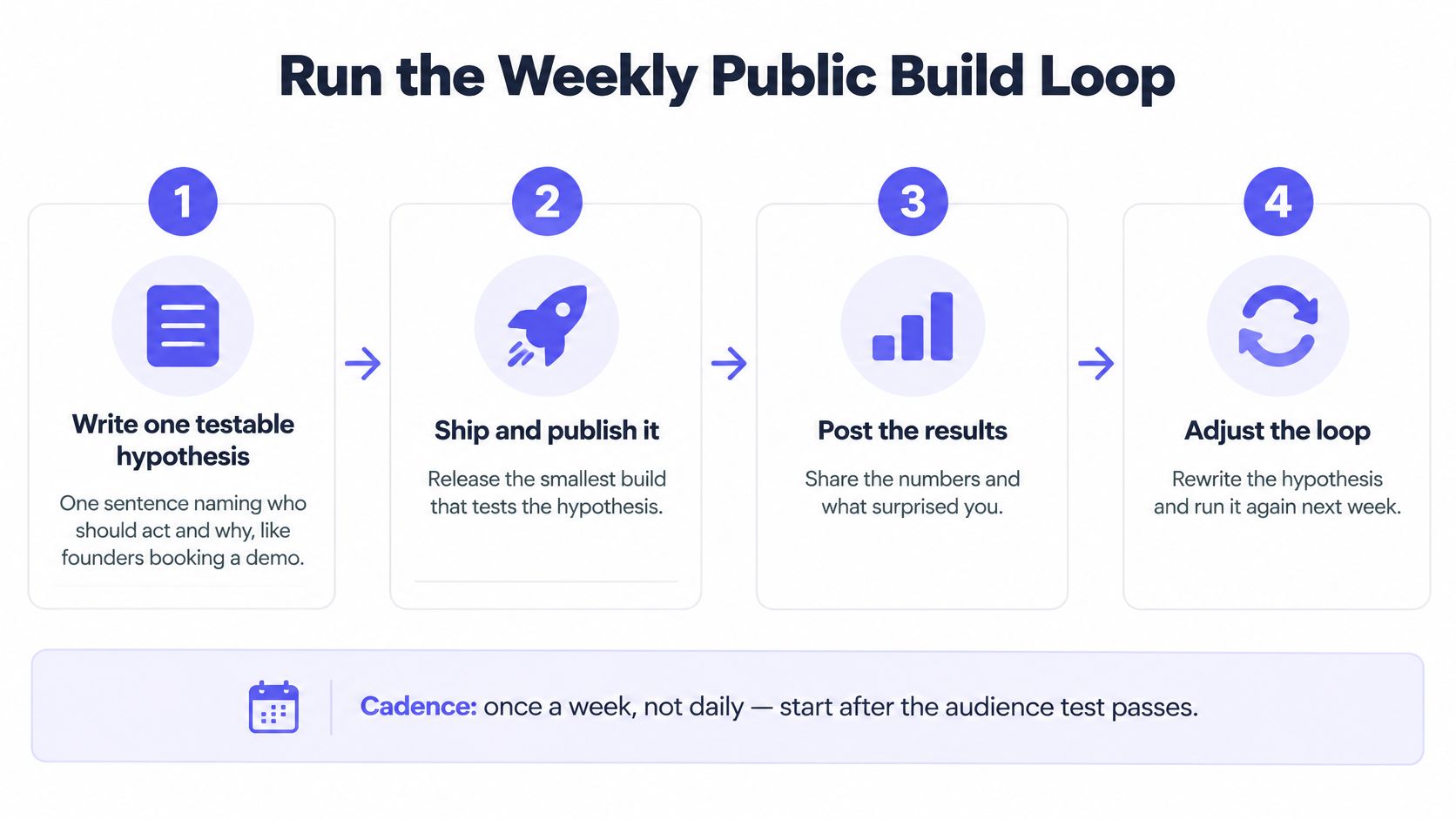
- Write one testable hypothesis in one sentence. Example: founders will book a demo if the teaser names the problem in the first three seconds. Name who should act, and name the action.
- Define the metric and the time window before you post. Write the denominator in the same note, whether that is profile visits, post impressions, or campaign-tagged sessions. Never change it halfway through the week, and don't report only the days that looked good.
- Build one launch-style asset with ShipTeaser. Paste a public product URL and ShipTeaser renders a 30-second 1080p MP4 in a few minutes. Any public page works, including a landing page, a product page, or an app site. The file is ready for X, LinkedIn, Product Hunt, or a launch page, with no export settings to configure, so the production step stays inside the time cap instead of eating it.
- Publish the asset with the hypothesis attached, plus one learning note from the week. One asset, one note. That pair is the post.
- On the scheduled day, record the result, including weak numbers, activated accounts, and campaign-tagged sessions. Then publish the next decision and the reason for it.
- Cap the routine at three hours a week. Stop checking engagement between those blocks. Replies can wait until the next block.
A SaaS content system for founders is useful here because the loop only survives if the writing has a slot on the calendar. If the post depends on leftover energy, it will die in week three.
The healthy sign is short. You can say what you tested, what happened, and what you will do next in two sentences. If you need a thread to explain the week, the hypothesis was too vague.
This walkthrough shows how a founder keeps that weekly cadence from turning into a second job.
After four weeks, keep the narrative type that produced activated accounts and drop the one that only produced attention. Post the winner where your buyers already are. A practical place to put the teaser and the decision note is a launch thread, and how to launch on X is the posting sequence I would follow so the asset isn't buried under a caption with no ask.
Stop rule: When the three hours are gone, the loop is done, even if replies are still arriving.
FAQ
Which channel should I test first?
The one where your buyers already discuss the problem you solve. A developer-facing product usually earns its first replies on X, while a tool sold to operators and founders tends to do better on LinkedIn. Commit to a single channel for the four-week test, because splitting the weekly budget across two feeds produces data too thin to read.
How many hours a week should it take?
Three hours, the same cap the weekly loop runs on, covering writing, posting and replies. When the cap is spent, the loop is done even if replies are still arriving. Add time only after activated accounts trace back to posts, since attention alone does not justify a bigger budget.
What if I have no audience yet?
Start with a small group that matches your buyer profile, post the problem and the test, and measure activated accounts instead of follower counts. Founders who report strong results usually brought an audience with them, so a cold account should expect a slow first quarter. Buying reach fills the room with people who will never sign up.
Can I share revenue numbers?
Yes, when the number clears every row of the share-or-keep-private table earlier in this article. One extra habit helps: publish the same metric on the same cadence, because a single revenue screenshot followed by silence reads worse than never posting one.
ShipTeaser reads the public product page you paste and renders a 30-second 1080p MP4 that is ready for X, LinkedIn, Product Hunt or a launch page, so the week's build log ships with a video artifact alongside the paragraph. Paste your page at ShipTeaser and put the first video in next week's loop.