You've built something people want, but your budget is tight, your launch date is approaching, and every channel looks like a possible answer. Should you post on X, write an SEO guide, contact founders directly, buy search ads, build a referral loop, or make a launch video? Early teams rarely fail because they lack ideas. They fail because they run disconnected activities without learning quickly enough from the results.
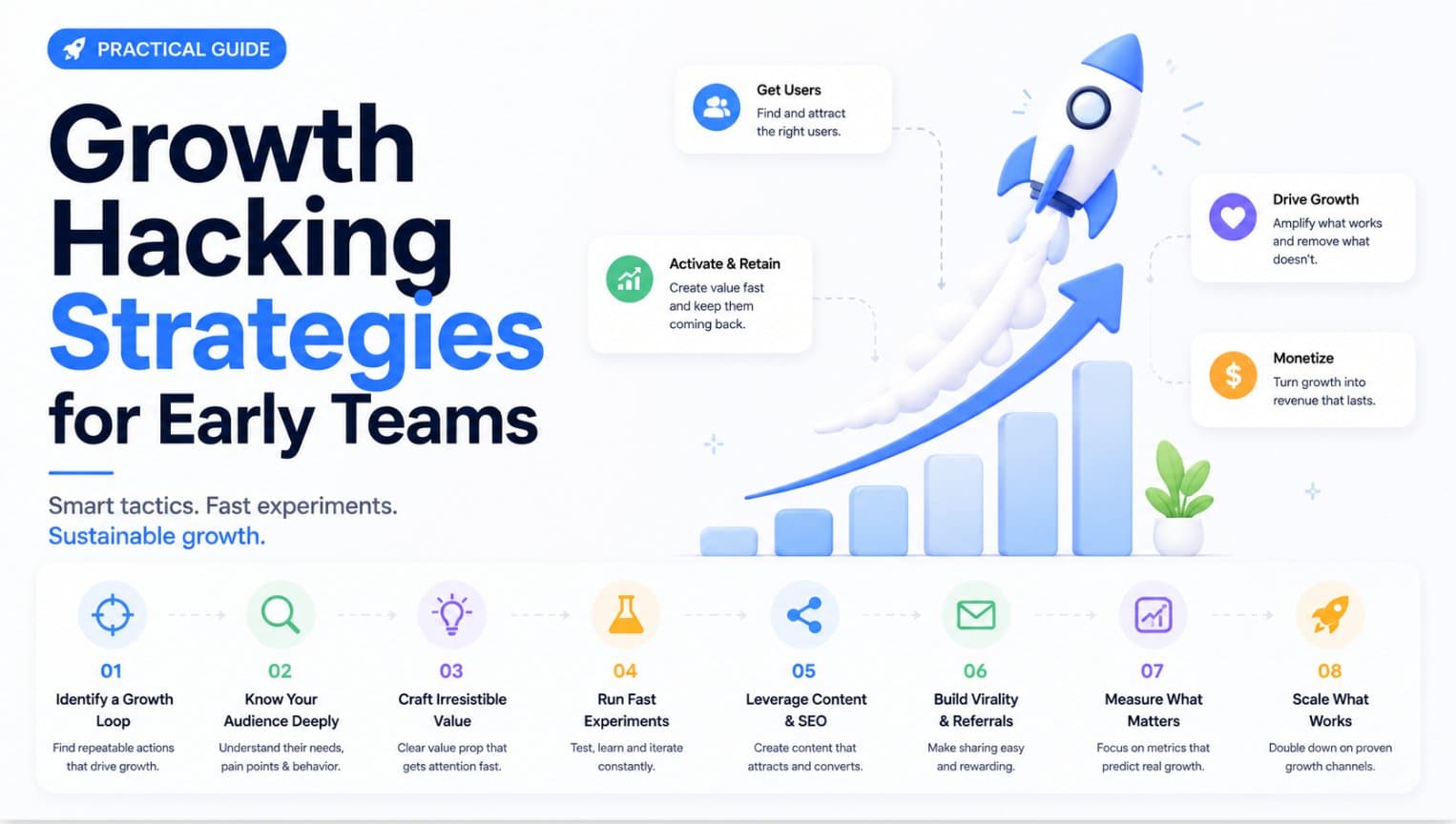
The most effective growth hacking strategies reduce time to learning. Each experiment should connect to a funnel stage, such as acquisition, activation, retention, referral, or revenue. Your existing product page, customer conversations, screenshots, and launch material should become reusable distribution assets rather than one-time campaign inputs.
Short, muted-friendly promotional videos are especially useful in this system. One concise teaser can support a launch page, founder outreach, social posts, partner content, email campaigns, and retargeting without requiring a full production workflow. The ten strategies below focus on building that repeatable weekly rhythm.
1. Product Hunt Launch Strategy
A Product Hunt launch works best as a concentrated distribution sprint, not as a page you publish and abandon. The audience includes makers, founders, early adopters, and product enthusiasts, so your message should quickly explain the problem, the product's distinctive value, and why someone should try it now.
Start preparing before launch day. Participate in discussions, support other makers, and build relationships with potential hunters instead of appearing only when you need votes. Prepare your product description, screenshots, FAQ, demo, founder profile, and response library in advance. A short teaser can give visitors a faster way to understand the product before they read the full page. You can plan that asset with a Product Hunt launch video workflow.
Turn launch day into a learning sprint
Recruit a credible hunter who understands the product and can stay engaged throughout the launch. Coordinate posts across founder communities, LinkedIn, and X before the launch, but don't make the campaign feel like a demand for votes. Invite people to test the product, ask questions, and share useful feedback.
Respond quickly to comments, especially during the opening part of the launch. Every reply should add information, address an objection, or reveal how users are thinking. A discount or extended trial can reduce hesitation, but it won't compensate for unclear positioning.
Practical rule: Treat Product Hunt as a research room with distribution attached. Track who visits, who signs up, where they hesitate, and which message earns the most interest.

2. Founder-Led Growth and Direct Sales Strategy
Early customers often buy confidence before they buy software. A founder can provide that confidence through direct research, personal onboarding, and fast responses that a generic campaign can't match.
Build a focused list of ideal prospects, such as indie makers, product marketers, and early-stage SaaS founders who regularly launch products. Find them through launch communities, professional networks, relevant forums, and existing relationships. Before contacting someone, review their product page and recent launch activity. Your message should identify a specific distribution or content problem, not just announce that your tool exists.
Offer a guided first experience when the product benefits from demonstration. For a URL-based promotional video tool, that might mean helping a founder choose the right page, reviewing the generated teaser, and asking where they plan to publish it. The conversation gives you product feedback while showing the prospect a concrete outcome.
Use personal contact to find your repeatable message
Follow up after the first interaction, but make each message useful. Ask whether the asset was posted, what response it received, and what would make the workflow easier. When a customer creates a strong teaser, ask permission to feature it and invite an introduction to another founder with a similar need.
Founder-led growth doesn't scale through volume alone. It scales when repeated conversations reveal a narrow audience, a clear promise, and an onboarding path that another team member or automation can eventually run.

3. Viral Social Content and Organic Social Media Growth
Social growth doesn't begin with “go viral.” It begins with a repeatable point of view and a steady supply of useful material. Founders respond to launch lessons, product teardowns, onboarding observations, and honest experiments more readily than polished claims with no evidence.
Create several content formats from one weekly product asset. A short teaser can become a launch post, a screen recording with commentary, a before-and-after explanation, a customer question, and a practical lesson for other builders. Keep the first seconds understandable without sound, because many people encounter social video in muted environments.
Build conversations, not a broadcast queue
Post where your audience already discusses its problems. X may suit fast launch commentary and founder conversations, LinkedIn may suit product marketing lessons, and short-form video platforms may suit visual demonstrations. Don't force identical copy across every channel. Adapt the opening, context, and call to action while keeping the central promise consistent.
Use this guide to launching on X when you need a more deliberate launch sequence. The important discipline is to respond to comments, quote useful community insights, and record which topics produce qualified visits rather than chasing reach alone.

A social post that earns attention but brings no activation isn't a complete win. Tag each post by theme and channel, then compare visits, signups, first successful use, and return activity.
Watch a practical product teaser in context:
4. Free Trial and Freemium Model Optimization
A free trial should prove the product's core value quickly. It shouldn't become a warehouse of restricted features that leaves users confused about what they're meant to do.
For ShipTeaser, the first successful action is clear: a user submits a product URL and receives a usable short promotional video. Design onboarding around that moment. Ask for only the information required to begin, explain what the system reads from the landing page, and show the user where to review or download the result.
Let usage create the upgrade moment
A free experience can include limited generation access, but the limit should appear after the user understands the output. Upgrade messages should connect to a real need, such as creating another asset for a new launch, maintaining a weekly cadence, or supporting more channels. Avoid interrupting the first useful action with a payment demand unless the business model requires it.
Track the path from signup to first generation, download, publication, and return use. Then test one change at a time, such as a shorter onboarding form, clearer example output, or a better explanation of paid access. The conversion rate improvement guide can support that work, but your own funnel behavior should determine the priority.
A free tier attracts attention, but retention determines whether that attention becomes a business. If users generate one video and never return, improving acquisition won't fix the underlying experience.
5. Viral Loop Mechanics and Referral Programs
Referral programs work when sharing feels like a natural extension of product value. A founder who has just created a launch teaser may already know other builders who need a similar asset. Your job is to make that recommendation easy, transparent, and worth completing.
Start with a reward that matches the product. Additional video credits, priority generation, or access to a useful feature may feel more relevant than an unrelated reward. A two-sided benefit can make the invitation easier to send because the new user receives value too.
Design the loop around a successful moment
Ask for a referral after a meaningful action, such as downloading a finished teaser or publishing it. Provide a pre-written message that the user can edit, but don't hide the relationship behind vague language. Clear attribution protects trust and helps you understand whether referrals create engaged users or only low-intent signups.
Keep the referral path short. A user should be able to copy a link or send an invitation without searching through account settings. Show the status of invitations and rewards, then remind users only when there is a real pending action.
A referral loop amplifies satisfaction. It can't manufacture satisfaction where the product hasn't delivered it.
Reward frequent advocates with recognition, early access, or useful product benefits rather than relying only on increasingly large incentives. Review referred-user activation and retention, not just invitation volume. A loop that generates many curious visitors but poor product use is an acquisition expense disguised as virality.

6. Content Marketing and SEO-Driven Organic Growth
SEO can become a durable acquisition channel when your content answers a problem your target customer already has. Early teams should avoid publishing broad articles just because a keyword appears popular. Choose questions connected to an actual product use case, such as creating a product launch video, writing teaser copy, or promoting a new SaaS release.
Build one strong guide, then support it with narrower articles. A founder searching for launch video examples may later need advice on scripting, distribution, social captions, and landing-page placement. Internal links should help that reader progress from education to a practical next step.
Create content from real customer friction
Use sales calls, support messages, launch questions, and failed experiments as source material. A precise article that solves a recurring problem will usually outperform a generic list of fashionable tactics. Explain the trade-offs. Tell readers when a short video helps, when a static screenshot is enough, and when paid distribution makes sense.
Structure pages so readers can scan definitions, steps, examples, and decisions. Add a clear call to action that matches the reader's stage. Someone learning how teaser videos work may need a template or example first, while someone preparing a launch may be ready to create an asset.
Repurpose high-performing articles into short videos, social posts, founder emails, and partner resources. This turns SEO into a content supply chain rather than a collection of isolated blog posts. Review older pages when the product, audience, or workflow changes, and update them with information you can verify.
7. Influencer and Creator Partnerships
Creator partnerships work best when the creator has a specific audience problem that your product can solve on camera. A founder-focused creator may need to explain a launch tool quickly. A no-code educator may want a visual way to demonstrate a workflow. A product marketing creator may need examples for a tutorial.
Start with relevance, not audience size. Study the creator's recent content, preferred format, and relationship with sponsored tools. Give them access to the product before discussing promotion. If the output isn't useful to them, a paid placement won't create credible advocacy.
Give creators a usable brief and creative freedom
Provide a few factual points, example assets, tracking links, and clear disclosure guidance. Don't script every sentence. The creator understands their audience's language better than your team does, and their natural demonstration may reveal a stronger use case than your original campaign.
Offer a simple way to measure performance, such as a unique link or code. Compare visits with meaningful actions, including completed generations, downloads, and continued use. A creator who drives fewer clicks but better activation may be more valuable than one who produces a large burst of curiosity.
Build relationships with the creators who explain the product accurately and attract the right users. An ongoing tutorial, launch review, or recurring workflow can create more learning than a one-off mention. Give strong partners new examples, early product access, and a reason to keep experimenting with the tool.
8. Community Building and Engagement Strategy
A community can become the place where users learn, share outcomes, and tell you what the product should improve. It shouldn't be treated as a support inbox with a branded header.
Choose a home that matches your audience's habits, such as a Discord or Slack space for active builders. Keep the initial structure simple. Create areas for launch wins, product questions, feedback, and useful resources. New members should know how to introduce themselves and where to post their first question.
Make member progress visible
Founder participation matters during the early stage. Answer questions, review member teasers, explain product decisions, and acknowledge useful criticism. If every discussion receives a promotional reply, members will stop treating the space as theirs.
Run recurring activities that create a reason to return, such as launch reviews, live teardowns, office hours, or showcase sessions. Turn repeated questions into documentation so the community improves the product's onboarding instead of increasing manual support forever.
Feature member launches with permission. Recognition gives users a reason to contribute, and the examples help new members understand what good use looks like. Ask for feedback after members publish an asset, then share which improvements came from that feedback. Trust grows when people can see their input changing the experience.
9. Strategic Partnerships and Integration Workflows
Partnerships become valuable when they remove a workflow gap for both audiences. A landing-page builder can help customers publish a product, while ShipTeaser can help those customers create a concise promotional asset from the same page. An email or social scheduling tool can help distribute that asset after generation.
Don't begin by pursuing a large ecosystem. Identify the workflow where your users already switch between tools, then choose one or two partners that can reduce that friction. Write the integration promise as a practical sentence, such as turning a published page into a downloadable teaser that is ready for a launch post.
Start with a narrow integration
A no-code connection, export option, template, or shared resource may be enough for the first test. A full API partnership can wait until you know users need it. Provide clear technical documentation when development is required, and define ownership for support before launch.
Co-marketing should teach a workflow rather than place two logos beside each other. Create a joint tutorial, workshop, or launch sequence showing how a user moves from product page to video to distribution. Track partner-sourced signups and activation so the partner can judge the collaboration on useful outcomes.
Integration can improve retention because the product becomes part of an existing routine. It can also increase complexity, support demands, and dependency risk. Keep the workflow understandable, document failures, and avoid building an integration that serves a theoretical audience rather than active users.
10. Paid Advertising and Retargeting Efficiency
Paid advertising is useful when you already understand the message that converts. It is a poor substitute for positioning research. If a visitor clicks an ad, reaches a vague landing page, and doesn't understand the next action, the campaign will buy you expensive evidence about a problem you could have discovered through direct conversations.
Begin with intent. Search ads should target people actively looking for a product video generator, teaser creator, or related solution, while social ads may work better when the creative demonstrates the output. Create a dedicated page for each promise. A founder looking for launch content shouldn't land on a page written for a large marketing department.
Retarget based on behavior
Separate visitors who viewed the page from users who started generation and users who downloaded an asset. Each group needs a different message. A page visitor may need a demonstration, while a user who generated a video may need a reminder to download, publish, or create another version.
Use conversion tracking that follows the funnel beyond the click. Compare ad source, signup, first successful generation, download, return use, and paid conversion. Pause creative that produces attention without qualified activity. Test one change at a time across the audience, promise, landing page, and creative so you know what caused the result.
Marketing automation is already part of the infrastructure for many teams. A 2026 industry summary reports that 95% of enterprise marketing teams and 78% of mid-market B2B organizations use at least one automation platform, while 34% use two or more. For a small team, that supports a practical approach: make paid campaigns feed reusable email, retargeting, and launch workflows instead of creating manual follow-up work.
11. Strategic Partnership and Integration Strategy
A second partnership motion deserves separate treatment because distribution partnerships and product integrations solve different problems. A distribution partner introduces your product to an audience. An integration partner embeds your product into the customer's existing workflow. Confusing the two creates vague agreements and weak execution.
For example, a founder community might promote a launch-video workshop, while a landing-page platform might connect page publication with teaser creation. The first relationship creates attention and education. The second can create repeated product usage.
Build the partner offer around shared incentives
Choose partners whose users already need concise launch and promotional assets. Offer a co-branded template, educational session, or export workflow that helps both teams serve those users. Give the partner a clear reason to participate, such as useful content for its audience, a tracked referral path, or a lower-friction experience for mutual customers.
Keep the first collaboration small enough to evaluate. A joint launch guide can reveal audience overlap before either team commits to engineering work. If the audience responds, add a deeper integration, shared onboarding, or recurring campaign.
Automation makes this model easier to operate. A submission can trigger asset generation, notify a partner team, add the user to a relevant email sequence, and record the source for later analysis. Keep consent, ownership, and branding clear. The best partnership feels like a better customer workflow, not a chain of promotions.
11-Point Growth Hacking Strategy Comparison
| Strategy | Implementation Complexity 🔄 | Resource & Speed ⚡ | Expected Outcomes 📊 | Ideal Use Cases 💡 | Key Advantages ⭐ |
|---|---|---|---|---|---|
| Product Hunt Launch Strategy | High, tight launch coordination, hunter prep 🔄 | Moderate cost, high prep effort; very fast spike ⚡ | Large 24‑hr qualified traffic spike; variable retention 📊 | Early-stage product launch to makers/founders 💡 | High visibility and social proof ⭐⭐⭐ |
| Founder-Led Growth & Direct Sales | Medium, personalized outreach and onboarding 🔄 | Low monetary cost, high founder time; quick conversion per lead ⚡ | High conversion/retention and rapid PMF feedback loop 📊 | Pre‑PMF, high-touch onboarding, early references 💡 | Highest conversion and loyalty ⭐⭐⭐⭐ |
| Viral Social Content & Organic Growth | Medium, consistent creative cadence and engagement 🔄 | Low–moderate resources; slow audience build, viral upside ⚡ | Growing brand presence and organic traffic; variable direct ROI 📊 | Brand building, founder thought leadership, shareable demos 💡 | Low-cost reach and authentic engagement ⭐⭐⭐ |
| Free Trial & Freemium Model Optimization | Medium, onboarding flows and usage caps design 🔄 | Requires infra/support costs; enables fast signups ⚡ | Large user funnel; conversion depends on onboarding effectiveness 📊 | Lowering adoption friction, proving value before purchase 💡 | Demonstrates value and fuels conversion/data ⭐⭐⭐ |
| Viral Loop Mechanics & Referral Programs | Medium, tracking, incentives, anti-fraud needed 🔄 | Low CPA when effective; growth can be exponential ⚡ | Higher-quality referrals and improved LTV if viral coef >1 📊 | Amplifying growth from existing user base 💡 | Low acquisition cost and viral amplification ⭐⭐⭐⭐ |
| Content Marketing & SEO-Driven Growth | Medium–High, steady content ops and technical SEO 🔄 | Low ad spend but time‑intensive; slow to mature (3–6+ months) ⚡ | Compounding organic traffic and long-term authority 📊 | Long-term acquisition, education, and high‑intent search capture 💡 | Durable traffic with low long-term CAC ⭐⭐⭐⭐ |
| Influencer & Creator Partnerships | Medium, research, negotiation, creative coordination 🔄 | Variable cost; can deliver rapid reach when aligned ⚡ | Qualified traffic and authentic endorsements; ROI varies 📊 | Niche communities, demo-driven campaigns, credibility boosts 💡 | Credible endorsements and targeted reach ⭐⭐⭐ |
| Community Building & Engagement Strategy | High, ongoing moderation and culture management 🔄 | Personnel‑intensive; slow to scale but high retention payoff ⚡ | Strong retention, advocacy, and product feedback loop 📊 | Ecosystem building for makers and repeat users 💡 | Deep engagement and defensible moat ⭐⭐⭐⭐ |
| Strategic Partnership & Integration Strategy | High, engineering integrations and partner ops 🔄 | Moderate engineering + partnership resources; long-term returns ⚡ | Increased stickiness, partner-driven acquisition and trust 📊 | Embedding in partner workflows (Webflow, Loom, etc.) 💡 | Scalable distribution and product lock‑in ⭐⭐⭐⭐ |
| Paid Advertising & Retargeting Efficiency | Medium, campaign setup, tracking, landing page optimization 🔄 | High budget required; fastest scalable acquisition ⚡ | Predictable, measurable acquisition; CAC sensitive 📊 | Immediate demand capture and retargeting warm leads 💡 | Fast, measurable growth with clear ROI metrics ⭐⭐⭐ |
Build the Loop Before You Scale the Channel
Growth hacking emerged as a formal startup discipline in 2010, when Sean Ellis coined “growth hacker” to describe a cross-functional approach centered on rapid acquisition, experimentation, and measurable growth rather than broad brand marketing. The discipline has since moved toward a full customer-journey model. In the 2023 State of Growth research, 80.4% of respondents defined growth hacking as experimentation across the funnel, while teams commonly organized around acquisition and existing-customer revenue. The same research found that 36.72% reported growth teams of 2 to 5 people, a useful reminder that this work is designed for constrained teams as well as larger organizations.
Start with one channel. Choose the place where your ideal customer already pays attention, then define one activation event that proves value. For a product-page-to-video workflow, activation might be generating and downloading a teaser. Create one small asset, publish it, contact a few relevant users, and review what happened before adding more channels.
Your weekly workflow can stay simple:
- Monday, choose the hypothesis: Identify one funnel problem and write down the change you expect to help.
- Tuesday, prepare the asset: Create the landing-page variation, email, outreach message, or short teaser required for the test.
- Wednesday, publish and distribute: Put the experiment in front of the chosen audience with tracking in place.
- Thursday, collect qualitative evidence: Read replies, watch recordings, review support questions, and speak with users.
- Friday, decide what happens next: Keep, revise, or stop the experiment, then document the learning.
Measure more than reach. Track channel-specific conversion, activation, retention, referral activity, and cost. A post with broad exposure may be less useful than a small founder conversation that produces repeated product use. A referral campaign may look successful at the invitation stage but fail if referred users don't activate. A paid campaign may produce clicks while the landing page loses every qualified visitor.
The 2026 growth experiment summary reports that across more than 5,000 experiments, only 12% produced statistically significant positive results. It also reports that teams commonly run 3 to 5 experiments per week, and that startups running 20 experiments per month grew 2.5 times faster than those running only 5 experiments per month, when success rates were similar. Those figures don't mean you should fill your calendar with careless tests. They show why disciplined volume, clear hypotheses, and reliable instrumentation matter more than waiting for one perfect idea.
Sequence your investment. Begin with founder-led conversations and hands-on onboarding, because they reveal the message and the activation barrier. Turn those learnings into reusable content and short video assets. Add referrals and community once users have a reason to share. Pursue partnerships when you can describe the workflow clearly. Use paid amplification after the message converts organically and the retention path makes sense.
AI changes the operating model by helping small teams create and compare more message, onboarding, and content variations. The current discussion of AI-led growth operations points toward hyper-personalization, micro-experiments, and multi-channel workflows, but the practical constraint remains human judgment. AI can produce variants quickly. You still need to choose the right audience, protect the user experience, interpret weak signals, and stop tests that create noise.
Retention deserves equal attention. Recent coverage recommends use-case-specific onboarding plus dynamic pricing and packaging rather than relying only on acquisition tactics, as discussed in this 2026 analysis of growth hacking strategies. A launch asset matters because it can bring someone in. A repeatable workflow matters because it gives them a reason to return, publish again, invite a teammate, or recommend the product.
ShipTeaser fits this operating system by turning an existing product landing page into a scripted, approximately 15-second promotional video that can be downloaded and posted. You can use the asset in a launch, outreach message, social post, partner workflow, or weekly content test, then measure whether it helps the next funnel step.
The strongest growth hacking strategies aren't isolated tricks. They're connected loops: a clear message attracts the right person, a fast activation delivers value, a useful asset travels through more than one channel, and retention gives the customer a reason to repeat the behavior. Build that loop before you scale spend.
ShipTeaser turns an existing product landing page into a short, ready-to-download promotional video, giving early teams a reusable asset for launches, social posts, outreach, and weekly experiments. Visit ShipTeaser to create a teaser from your product URL and put this growth system into practice.