Corporate video pricing ranges from $99 a month for automated URL-to-video tools to over $40,000 for traditional agency productions. Early-stage software founders should pay for automated throughput, not a cinematic asset they'll publish once and abandon.
The popular advice says to price video by the finished minute. That advice works for brand films, television spots, and large corporate campaigns. It fails when a solo builder needs a fresh product teaser every week, fast enough to match shipping velocity.
The Per-Minute Pricing Trap For Startups
The finished minute is the wrong unit for early-stage software launches. Founders with limited runway and changing products need short, clear assets that explain what shipped and give people a reason to click, not a three-minute company documentary.
Traditional corporate video production often runs $1,000 to $10,000 per finished minute, while professional projects commonly cost $3,000 to $50,000 overall, depending on crew size, talent, locations, and post-production complexity, according to independent corporate video pricing guidance. A two-to-three-minute explainer can cost $4,500 to $20,000, and an agency-managed project can average about $42,000. Automated tools can cost under $200 a month. Those figures make the buying decision clear: compare publishing capacity, not runtime alone.
The finished-minute model reflects how traditional productions sell labor. More planning, filming, editing, animation, and review time usually increase the invoice. That structure fits a permanent homepage film, recruitment campaign, or polished brand statement with a substantial crew.
A founder posting a silent teaser on Product Hunt, X, or a mobile-first channel faces a different constraint. Runtime is not scarce. Iteration speed is.
One polished asset can become outdated as soon as the headline changes, positioning shifts, or the interface updates. The founder paid for a frozen snapshot while the software kept moving.
Practical rule: Price launch video by the number of usable assets you can publish each month, not by the seconds in one export.
Ask, “What does one consistent weekly launch asset cost?” That measure connects video spending to shipping cadence, distribution, and learning. The broader market appears in RemotionAI's pricing guide, while this breakdown of product video cost applies the same cost logic to software launches.
For an early-stage team, the winning production path is the one that keeps each release easy to explain and fast to publish. A lower per-asset cost creates room for more tests, more launches, and faster feedback.
Agency Production Costs And Hidden Delays
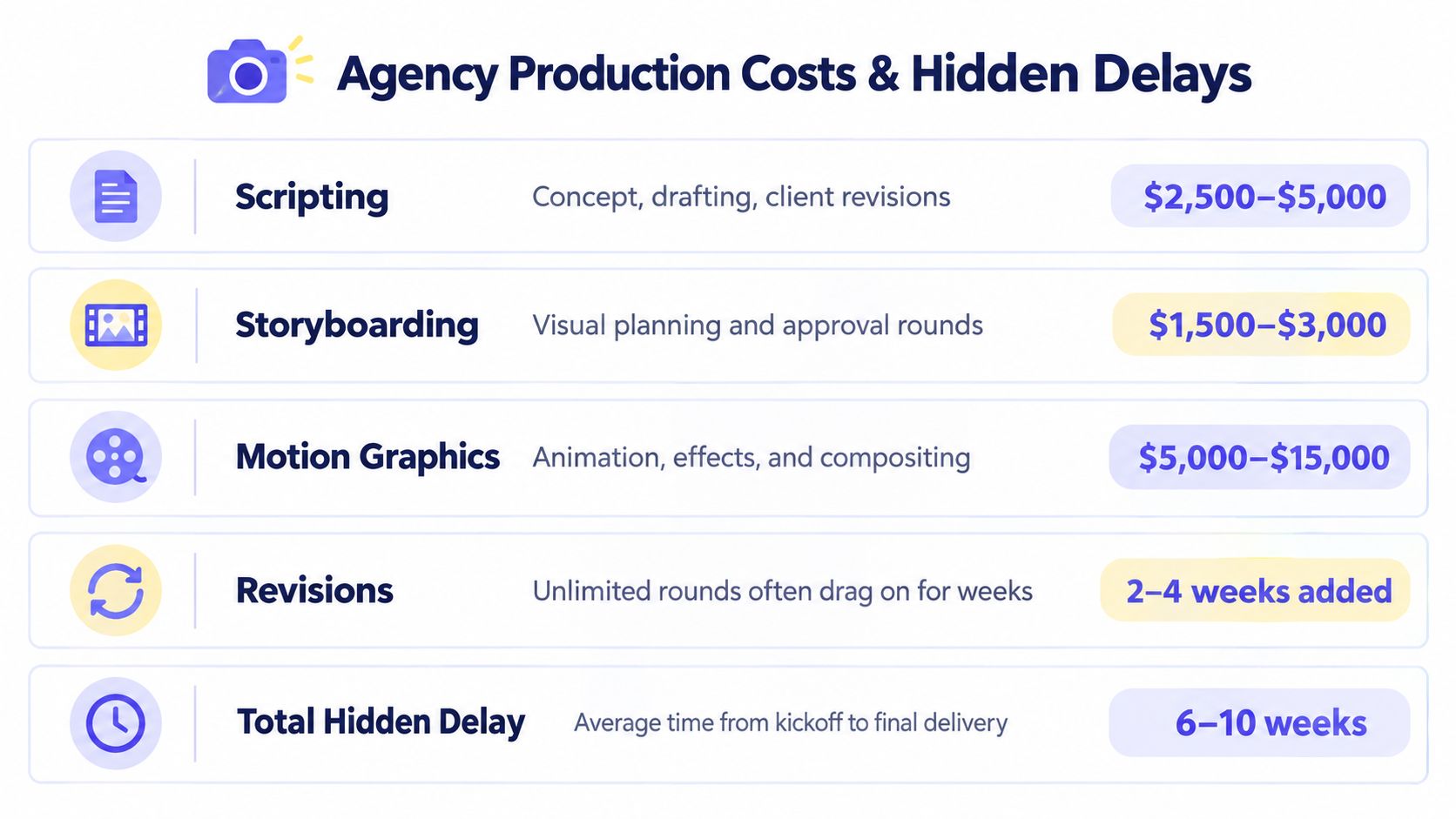
Agency quotes rarely cover editing alone. They bundle strategy, creative direction, scripting, storyboarding, filming, sound, motion graphics, color work, delivery versions, project management, and revisions. Each service may make sense for a major campaign. Together, they create a process built for a high-stakes brand film, not a startup that needs a usable launch asset every week.
Traditional studio production for a 60-second explainer commonly costs $4,000 to $10,000. US studios average $12,667 for the same runtime, while European studios average $5,662, according to this corporate video production cost analysis. Conventional mid-tier professional work often falls around $5,000 to $25,000 per video, and high-end traditional production can reach $30,000 to $300,000 or more.
Where the invoice grows
The process starts with discovery calls. The founder explains the product, reviews creative directions, and helps turn technical features into a script. Storyboards require approval before production begins. Animated interfaces, transitions, branded typography, and custom visual treatment add more production work.
The quote reflects scope more than runtime. Simple interview-style corporate videos cost around $5,000 to $7,500, recruitment campaigns around $5,000 to $25,000, and multi-video enterprise series around $25,000 to $250,000 or more, as described in this corporate video production cost guide.
The larger expense is founder attention. A short video can consume discovery calls, feedback sessions, approval threads, and follow-up messages. A minor copy change may arrive after the project is marked complete, forcing the team to reopen a workflow designed to close.
That delay matters more than polish for weekly software launches.
A three-week turnaround for one teaser creates a bottleneck when the product ships updates every week. By delivery, the feature may have changed, the launch date may have moved, or customer feedback may have invalidated the original message. The team then receives a polished asset for an outdated moment.
Remote coordination can remove travel, but it does not automatically remove approvals, handoffs, revision queues, or production dependencies, as explained in this guidance on remote video production.
A polished video delivered after the launch is a polished late asset. Late assets don't compound distribution.
Agency production still fits videos that must represent the company for years, support a major fundraising narrative, or anchor a permanent brand campaign. It should not be the default for weekly software launch communication. Measure the process by usable launch assets delivered per week, not by the production value packed into one finished minute.
The True Cost Of In-House Video Editing
DIY editing looks inexpensive because the subscription invoice is visible. Founder time stays off the spreadsheet, even though it is usually the larger cost.
Before publishing a teaser, a solo builder must learn the editor, organize source material, choose a visual rhythm, create motion, select music, write on-screen copy, export multiple versions, and check each format. None of that work improves the product. It delays the work that does.
The founder-time calculation
Do not price your own hours at zero. An afternoon spent editing comes from product development, customer interviews, support, fundraising, or distribution. Every hour spent adjusting keyframes is an hour not spent fixing onboarding friction or testing a launch message.
Small decisions multiply the workload:
- Asset hunting: Finding usable visuals takes time, especially when the story depends on interface screenshots and accurate feature context.
- Timeline mechanics: Trimming clips, adjusting transitions, aligning text, and correcting spacing turn a short teaser into manual production.
- Revision loops: Editing often exposes weak positioning, so founders keep changing the opening scene, headline, and call to action.
- Export checks: A horizontal composition may need different text placement in square and vertical versions.
Format creates more work
A launch asset rarely serves one feed. A founder may need a wide version for a professional post, a square version for compact social placement, and a vertical version for mobile-first short-form distribution. Each ratio changes the composition. Text that feels balanced in a wide frame can become crowded when stacked vertically.
9:16 vertical video is required for Shorts and mobile viewing, so aspect ratio affects distribution rather than serving as a cosmetic choice. Prepare each composition deliberately instead of treating alternate exports as an afterthought.
If the workflow requires a founder to become an editor before the first post goes live, the workflow is too expensive for a weekly launch cadence.
Manual editing makes sense only when editing itself is part of the craft a founder wants to build. For most software builders, the better path is a constrained generation workflow that turns existing product material into repeatable weekly launch assets. This guide to on-brand video without a designer addresses the practical brand problem while recognizing that manual editing carries a real opportunity cost.
Judge the process by usable assets delivered per week, not by the polish packed into one finished minute. That pricing unit matches how early-stage software teams launch.
Automated Teaser Generation With ShipTeaser
Traditional video quotes reward finished minutes. Startup launches need finished assets every week. ShipTeaser changes the pricing unit to recurring output, giving founders a practical way to fund feature announcements, waitlist updates, and product notes without commissioning a new production each time.
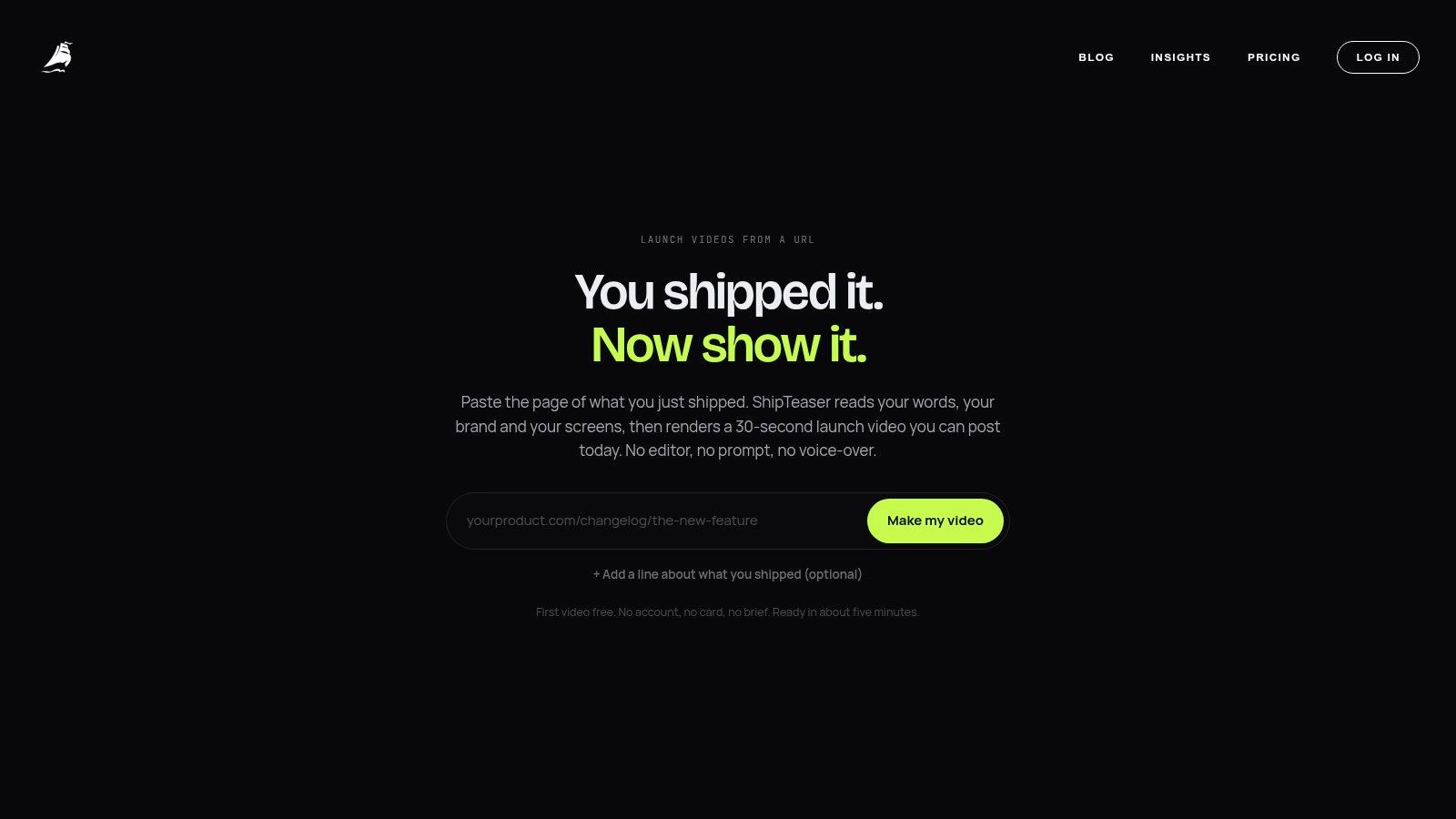
ShipTeaser starts with a product URL, analyzes the landing page, and produces a 15-second, 1080p, silent motion-graphics teaser in about two minutes, ready to post. Silent means no voice-over or narration. Add an optional music bed when the post benefits from music.
The workflow stays narrow and repeatable:
- Paste the product URL. The landing page supplies product copy, screenshots, and visible brand cues.
- Let the system assemble the story. The teaser uses five scenes: hook, problem, solution, proof, and CTA.
- Review the message. Confirm that the first scene names the product clearly and the final scene gives viewers one action.
- Export the needed ratios. ShipTeaser supports 16:9, 1:1, and 9:16.
- Post on a cadence. Repeat the process for a feature launch, waitlist update, or weekly product note.
The 15-second format fits established teaser guidance, which places effective teaser lengths in the 6 to 15 second range and identifies 15 to 30 seconds as a practical sweet spot, as summarized in this product launch video guide. The five-scene sequence gives each asset a clear job: attract attention, explain the problem and solution, establish proof, then direct the viewer to act.
What the plans buy
The first video is free, and no credit card is required. Paid plans are tied to weekly output:
- $99 per month: One video per week.
- $149 per month: Two videos per week.
- $199 per month: Four videos per week.
Evaluate the plan against the number of launch moments that need a visual asset. The buyer avoids a shoot, a crew, and a timeline editor, while retaining a repeatable process for publishing.
For founders reviewing short-form workflows, the StreamGen guide to short-form clipping explains how concise video assets can fit into a broader publishing process. ShipTeaser stays narrower by design. It creates a product teaser from a URL, and the AI teaser video maker from ShipTeaser keeps that URL-first process focused on launch velocity.
Choosing The Right Production Path
The correct production path depends on the asset's job. Don't ask whether a video looks expensive. Ask whether the production method supports the decision the video needs to influence.
An early-stage founder launching a feature on Product Hunt needs speed, clarity, and enough variations to test messaging. A founder building a permanent homepage for a mature company may need a more deliberate brand treatment. Those are different jobs, so they deserve different budgets.
Video Production Decision Matrix
| Production Method | Typical Cost | Turnaround Time | Best Use Case |
|---|---|---|---|
| Automated URL-to-video workflow | $99 to $199 per month | About two minutes for a teaser | Weekly launch assets, feature announcements, waitlist updates |
| Founder-led manual editing | Subscription cost plus founder time | Variable and dependent on editing skill | Occasional videos when the founder already edits confidently |
| Mid-tier studio production | $5,000 to $25,000 per video | Multi-stage production schedule | Product explainers, campaign assets, planned company narratives |
| Agency-managed production | About $42,000 average for an agency project | Extended planning and review cycle | Custom brand films with strategy, filming, and post-production |
| High-end traditional production | $30,000 to $300,000 or more per video | Longest and most complex path | Large campaigns, premium brand work, multi-location productions |
The automated row is the rational default for a solo builder who posts weekly. It keeps the financial commitment below the cost of a conventional production while matching the need for repeated outputs. The agency rows make sense only when the audience, message, and shelf life justify the production overhead.
Match the method to the launch
Choose an automated workflow when the product is changing quickly, the founder is testing positioning, or the content goal is regular visibility around shipping. A 15-second teaser gives each update a defined container. That constraint is useful. It prevents the founder from turning a simple feature announcement into a sprawling production.
Choose a studio or agency when the asset has a long shelf life and a large strategic role. A permanent homepage film, a major recruitment campaign, or a high-stakes company narrative can justify scripting, filming, talent, and detailed post-production.
Don't hire an agency because a video feels important. Hire one because the video's expected use, longevity, and audience demand the agency's capabilities. Otherwise, spend the budget on more launch attempts, better product messaging, or direct customer conversations.
Frequently Asked Questions
Do launch videos need voice-over to convert
Launch videos do not need voice-over by default. A silent, text-driven motion-graphics teaser works while viewers browse with sound muted and avoids the cost of narration or founder recording. Build the message around a clear hook, the problem, the solution, concise proof, and one CTA. Add music only when it supports the pace without competing with the text.
What length should a software product teaser be
Keep a software teaser short enough to communicate one idea without explanation. A 15-second format gives each weekly launch asset a defined container, helping founders publish quickly instead of turning a feature announcement into a full production. Use the opening seconds to identify the product, then reserve the final scene for one direct action.
How can founders keep automated videos on brand
Use the landing page as the source of truth. Keep the product name, core promise, visual cues, and CTA consistent, then check every generated asset for outdated copy before publishing. A constrained five-scene structure keeps the communication pattern stable while the feature, proof point, or launch message changes.
Review speed matters as much as visual consistency. If approval takes longer than the product update deserves, simplify the template and reduce the number of decisions required.
Is $99 a month enough for a weekly launch cadence
The $99 per month plan fits a weekly publishing rhythm when one teaser supports each release. Founders publishing more frequently can choose the $149 per month plan for two videos per week or the $199 per month plan for four videos per week. Test the free first video before paying, then judge the plan by its contribution to a real publishing habit, not by finished-video pricing alone.
ShipTeaser turns a product URL into a 15-second, 1080p silent motion-graphics teaser in about two minutes, with 16:9, 1:1, and 9:16 exports for launch distribution. Try the free first video with no credit card, then visit ShipTeaser and choose the monthly cadence that matches your shipping schedule.