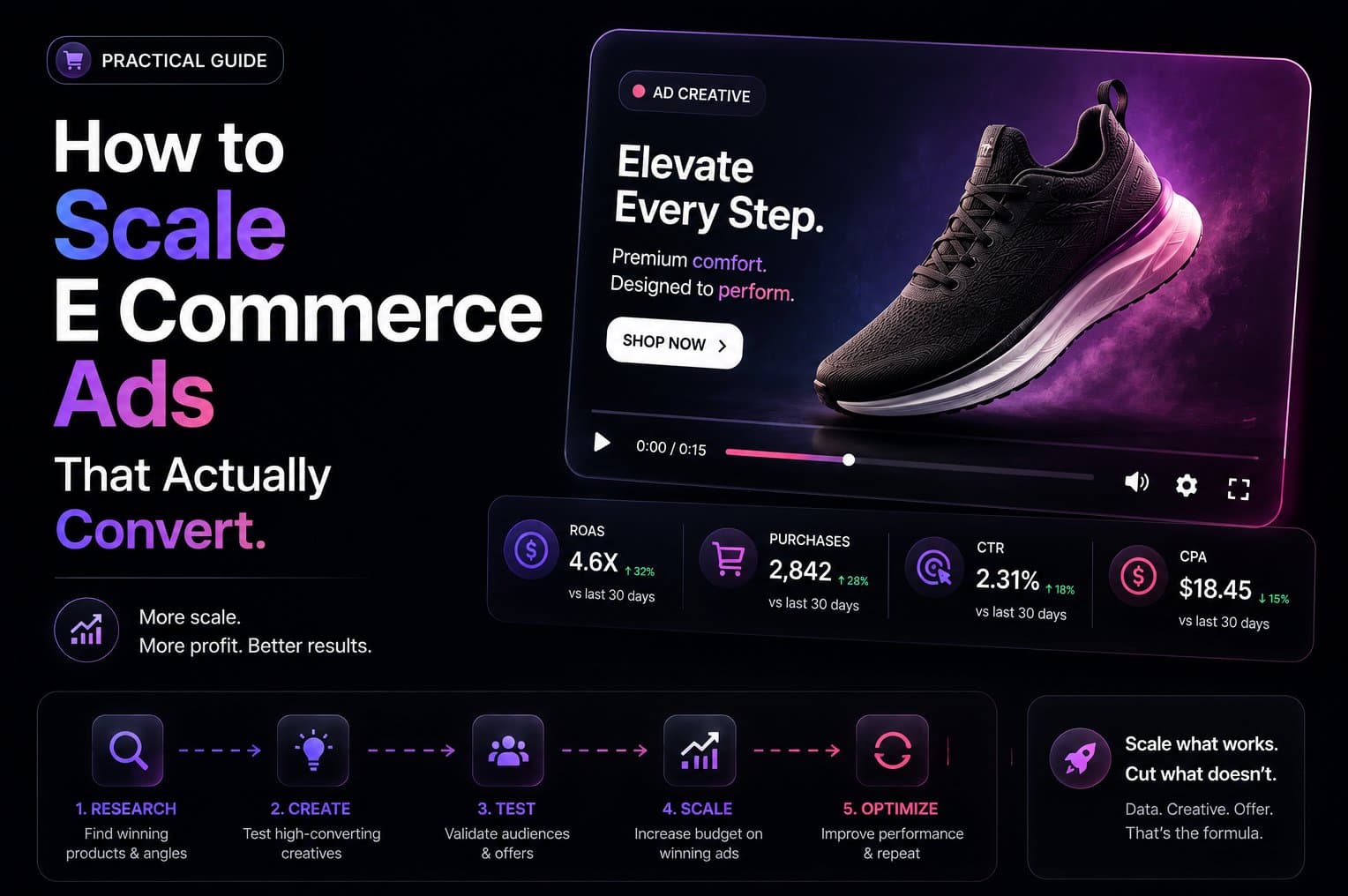
Most advice about e commerce ads starts in the wrong place. Founders get told to pick a platform, copy a competitor, and “test more.” That burns money fast. The true fight is earlier. It's the creative-and-angle system. If you can't say the right thing to the right buyer, the platform just gives you a faster way to lose.
The market is already too big to fake your way through it. Global ecommerce ad spend is projected to reach $271 billion in 2025, and global ecommerce sales are projected at $6.86 trillion in 2025 (source). Digital is where the money moved, too, with one 2025 source saying digital makes up about 69% of total global ad spend, another putting ecommerce ad spend at 63% digital in 2025, and digital video ad spend projected at $72.4 billion in 2025 after $63.8 billion in 2024 (source). That means your advantage won't come from “being on ads.” It comes from shipping sharper creative faster than the next team.
Why Most E Commerce Ads Lose Money
The usual mistake is treating platform choice like the hard part. It isn't. The leak starts earlier. Weak angles, vague promises, and no honest feedback loop turn paid traffic into expensive noise. You do not have a media problem. You have a message problem.
The budget leak starts before launch
A bad campaign can look busy for weeks. Impressions arrive. Clicks show up. The dashboard stays green. If the offer is unclear or the angle misses buying intent, you are paying for attention from people who were never close to buying.
The fix is precision, not more spend. Start with claims you can defend and angles you can prove. The FTC says ads must be truthful and non-deceptive, and advertisers need evidence to back claims with a reasonable basis (FTC guidance). The FTC's internet advertising rules go further. If an ad implies an outcome, you need proof behind it, especially for performance claims (FTC rules). That strips out sloppy copy fast, which is exactly the point.
A concrete example is simple. If one version of an ad says “reduces checkout friction” and another says “saves 2 clicks at checkout,” the second version gives you a testable claim. It is easier to measure, easier to defend, and easier to kill if it fails. That is how precision improves performance. You stop guessing and start learning from the market.
Practical rule: if you cannot defend the claim before the ad goes live, do not put it in the ad.
That is why so many small teams lose money. They treat ads like a distribution task. It is a selection task. Pick the wrong angle and you buy the wrong clicks.

Platform is the easy decision
The platform is just the container. Search, social, display, video, and marketplace placements each do a different job, but none of them rescue weak creative. If the ad says nothing memorable, the channel will not save it. If the angle is sharp, even a modest budget tells you something useful.
The operator move is simple. Test the message before you scale the spend. Decide what the ad is meant to prove, then measure whether the market agrees. That is where control starts.
The Core Ad Types and Where They Fit
Start with the job, not the vendor. That keeps you from building a strategy around whatever interface someone taught on a webinar. A small team should think in four buckets, capture intent, create intent, retarget and remind, then reach new people.
Match the format to the buying job
Search is for existing demand. People are already looking for something specific, so this format works best when the product solves a known problem or maps cleanly to a known category. Shopping-style placements do the same thing, but with a more visual product-first presentation.
Social and video are for creating demand. These formats interrupt the scroll and need a sharper hook. They're useful when the buyer doesn't know your product yet, or when the product needs a fast explanation. Display is more useful for reminder work, especially when someone already visited a page and needs another nudge.
Retargeting is not magic. It only works if the first visit was meaningful. If the page was vague, the retargeting pool is just a pile of undecided traffic. Marketplace placements can beat a paid funnel outright when the listing already has the trust signals and convenience a buyer wants.
| Ad type | Growth job | Creative effort | Learning curve |
|---|---|---|---|
| Search | Capture intent | Low | Moderate |
| Shopping-style placements | Capture intent | Low to moderate | Moderate |
| Social | Create intent | High | Moderate |
| Video | Create intent | High | Moderate |
| Display | Retarget and remind | Low to moderate | Low |
| Marketplace placements | Convert existing demand | Low | Low to moderate |
Think in sequences, not silos
A founder should not ask, “Which platform is best?” Ask what the buyer already knows. If the buyer is searching, lead with search. If the buyer needs context, lead with social or video. If the buyer already touched the site, retargeting can clean up the edge cases.
That sequence matters more than channel loyalty. One format captures demand. Another creates it. Another brings back the people who hesitated. If you use them in the wrong order, you pay for the same person three times and call it a strategy.
Choosing a Platform Without Chasing Trends
Platform choice matters, but not the way gurus talk about it. Don't start with what's hot. Start with margin, intent strength, and what your creative can carry. A category with thin margin can't survive sloppy acquisition. A category with strong intent can afford a more direct format. A category with visual appeal needs creative that shows the product fast.
Use margin and intent as the first filter
If the product is searched for directly, intent is already there. That makes search and marketplace-style placements the obvious first tests. If the buyer is still discovering the category, social and video usually have more room to shape interest. If the product has a simple visual payoff, a short teaser can do more work than a long explanation.
The clothing benchmark dataset is a useful reminder that channel economics differ by product type. In that dataset, Meta Ads showed a $11.13 CPA and 982% ROAS, while Google non-brand showed a $19.41 CPA and 563% ROAS (AdScale benchmarks). I'm not telling you to copy those numbers. I am telling you that your category matters more than generic advice. What works for apparel won't automatically work for a tool, a consumer gadget, or a new subscription product.

Make the format earn the budget
Pick the channel that matches the creative you can produce repeatedly. Search wants clarity. Social wants a hook. Video wants motion and a reason to keep watching. If your team can't create enough variant quality, don't pretend the platform will compensate.
That's why I like short motion-led assets for early testing. A 15-second silent teaser gives you a clean way to test the product story without building a giant production process. ShipTeaser does this from a product URL, which fits the founder workflow better than a long creative brief, and its own docs on video marketing are useful for thinking about how short assets fit into a broader plan (best practices for video marketing). Use the format that lets you move faster with less waste.
A blunt decision rule
If buyers already know the category, favor intent capture. If they need education, favor format-driven discovery. If your margin is tight, avoid channels that need a lot of expensive trial and error. If your creative is weak, don't pour money into the channel that punishes weak creative the hardest.
That's the decision rule. Not “what's trending.” What can you afford, what do buyers already believe, and what can your team produce again next week?
Creative Systems That Produce Winners
Money gets wasted when teams treat e commerce ads like a media-buying problem first. It is a creative system problem. Small teams need a repeatable way to pick angles, write hooks, and learn from the market without turning every test into a production mess. The goal is simple. Find one message that can carry spend, then build from there.
Start with one angle, not ten
Most public advice on ad angles stops at a list: Problem-solution, social proof, urgency, founder story. That is too shallow. The key question is which angle fits the buyer's hesitation right now. A new launch does not need every angle. It needs the right one.
Use the product page as a starting point, but do not copy it blindly. Pull the claims that match purchase intent, then pressure-test them against customer comments, objections, and proof points. The hard part is separating a nice feature from a message that makes someone act. That gap is where most guides fail.
Operator rule: use page copy to find the angle, then use real buyer objections to decide whether that angle deserves budget.
Build three hooks off one idea
Once the angle is chosen, write three hooks from it. Keep the structure different. One can be direct. One can lead with the pain. One can lead with the outcome. The point is not creativity for its own sake. It is finding which opening stops the scroll.
Then render those hooks into a format the platform can deliver cleanly. For display, the delivery limits matter. Amazon's specs note mobile detail and search placements using a 2x asset such as 828×250 pixels for a 414×125 slot with a 100 KB max file weight, while the mobile medium rectangle requires 600×500 pixels at 2x and only 40 KB (Amazon ad specs). That means compression, legibility, and safe cropping are not polish issues. They decide whether the asset survives delivery.
Use silent motion to test faster
For video, the engineering tradeoff is clarity inside a short window. Adobe's DSP guidance accepts MP4/H.264 with progressive scan and 29.97 fps for NTSC, and recommends 1280×720 at 1500 to 2500 kbps or 1920×1080 at 2500 to 3500 kbps. Amazon's policy guidance also accepts common video formats and allows up to 2 minutes (Adobe DSP specs). For a 15-second teaser, the job is straightforward. Make the product readable. Make the motion support the message. Do not bury the offer.
Short silent teaser assets fit this loop well. They let you test a hook fast, then keep the winner and kill the rest. ShipTeaser turns a product URL into a finished 15-second silent motion-graphics teaser, which fits a founder workflow better than a long creative brief. Learn more about landing-page video creation here. Use it to test the angle before you spend on heavier production.

Measure the creative, not just the click
If one hook gets attention and another gets ignored, that is useful. If one keeps people watching and another loses them early, that is even more useful. The first job of creative is to earn a second look. The second job is to carry the promise far enough that the click means something.
The strongest creative system is boring in the best way. One angle. Three hooks. One format. A weekly review. Then a fresh batch. That rhythm beats random bursts of inspiration.
Targeting and Bidding for Small Budgets
Targeting gets overcomplicated fast. Most early-stage teams don't need more complexity. They need fewer mistakes. Start broad enough to let the platform learn, then narrow only when you have a reason. Exclusions matter more than clever layering at the beginning.
Keep the audience logic simple
Broad audiences help when you have little data and a product that needs room to find buyers. Narrow audiences make sense when the offer is specific and the signal is already strong. Retargeting pools are tiny at small scale, so don't expect them to carry the account by themselves. They're a cleanup layer, not the whole plan.
Use exclusions to stop waste. Exclude recent buyers, bad-fit segments, and anyone who already took the action you're paying to get. If you don't, you'll pay to talk to the same people over and over. That's not optimization. That's leakage.
Bid like margin matters
Bidding should follow business reality, not ego. If you don't know the margin, you can't know the ceiling. If you can't survive a few bad days of learning, don't bid aggressively on day one. Start in a way that keeps the account alive long enough to produce signal.
Manual bidding can help when you need control and the dataset is tiny. Automated bidding becomes more attractive once the system has enough clean conversion data to read. The mistake is using automation to hide a weak offer. It won't.
Good default: let targeting stay broad enough to learn, and use bidding discipline to protect margin until the creative proves itself.
Measurement and Attribution You Can Trust
A lot of founders think they have a scaling problem when they really have a measurement problem. The ad account says one thing. Cash flow says another. The spreadsheet sits in the middle and hides the gap. You need a stack that tells the truth, even when the truth is inconvenient.
Track the basics before you trust the dashboard
Get the tracking right first. If events fire late, fire twice, or fail completely, every decision after that gets shaky. UTMs need one naming system. Landing page visits, product views, add-to-cart actions, and purchases should all be easy to follow from click to checkout.
Platform-reported ROAS helps, but it does not tell the full story. Last-click attribution gives too much credit to the final touch. That makes it easy to scale the wrong campaign and cut the one that introduced the buyer. You need a weekly habit of checking whether the campaign created new revenue or just claimed a sale that was already close.
Use surveys and holdouts when the numbers feel too neat
Post-purchase surveys are blunt, and they still matter. If enough buyers say they found you through a channel the platform undercounts, take that seriously. Holdout tests are stronger when you can run them cleanly. They show whether the ad changed behavior instead of just appearing near the conversion.
The same logic applies to multi-touch thinking. One impression rarely closes a sale alone. It usually works as part of a sequence. A simple click report can make you cut the creative that introduced the product and kept the customer moving. Use that report with caution, not faith.
The FTC expects advertisers to support the claims they make, so your measurement system should back up any statement about what a campaign, format, or claim delivered. Read the FTC's advertising guidance and keep your proof clean. Measurement is part of proof. It is not a bonus layer.

Weekly and monthly discipline
Weekly, watch creative performance, spend concentration, and obvious waste. Monthly, ask a harder question, did the campaign add profitable revenue or just move money around. If a channel keeps losing after full cost, cut it. If a hook keeps winning, feed it with fresh variations before fatigue shows up.
That's how you avoid self-deception. The account should answer one question, did this create profitable demand or not?
If you need to tighten the landing page before you trust the numbers, use this conversion rate improvement guide as a practical starting point.
Scaling Without Breaking What Works
Scaling usually breaks for one of four reasons, creative fatigue, audience saturation, rising media costs, or unit economics that were never strong enough to begin with. The fix is rarely dramatic. It's disciplined. Refresh hooks before they go stale. Expand audiences deliberately. Kill weak spend fast.
Don't scale the same message forever
One strong ad can carry a launch. It can't carry a year. People get tired of seeing the same claim, the same visual, and the same ending. When that happens, performance slides and teams panic. They often respond by increasing spend instead of changing the creative.
That's the wrong move. Keep the winning angle, but rebuild the hooks around it. If the product story is real, it can support new openings. If the story only worked once, it wasn't really working.
Protect the economics
Every scaling decision should pass a margin test. If the cost structure can't survive a few imperfect days, don't force volume. Cut underperformers early. Keep the spend concentrated enough to learn, but not so concentrated that one tired asset can sink the account.
The founder move is simple. Keep a weekly creative cadence. Test one new hook against the current winner. Watch for saturation. Expand only when the message still holds. That's how you grow without turning profit into a guess.
ShipTeaser makes short product-launch teasers from a product URL, which gives founders a clean way to test hooks without turning creative into a production project. If your ads need stronger opening assets, use ShipTeaser to turn one product page into a 15-second silent teaser, then use that as the first creative test this week.