You've probably got the product ready, maybe even the landing page, and now the hard part is obvious. Launching isn't just posting a link and hoping the right people notice. In app launch marketing, the winners treat the launch like a system, not a day on the calendar.
The practical goal is retained qualified users, not raw downloads. A launch that brings in installs but no real activation burns time, confuses the team, and gives you a false sense of traction.
The Four Phases of an App Launch
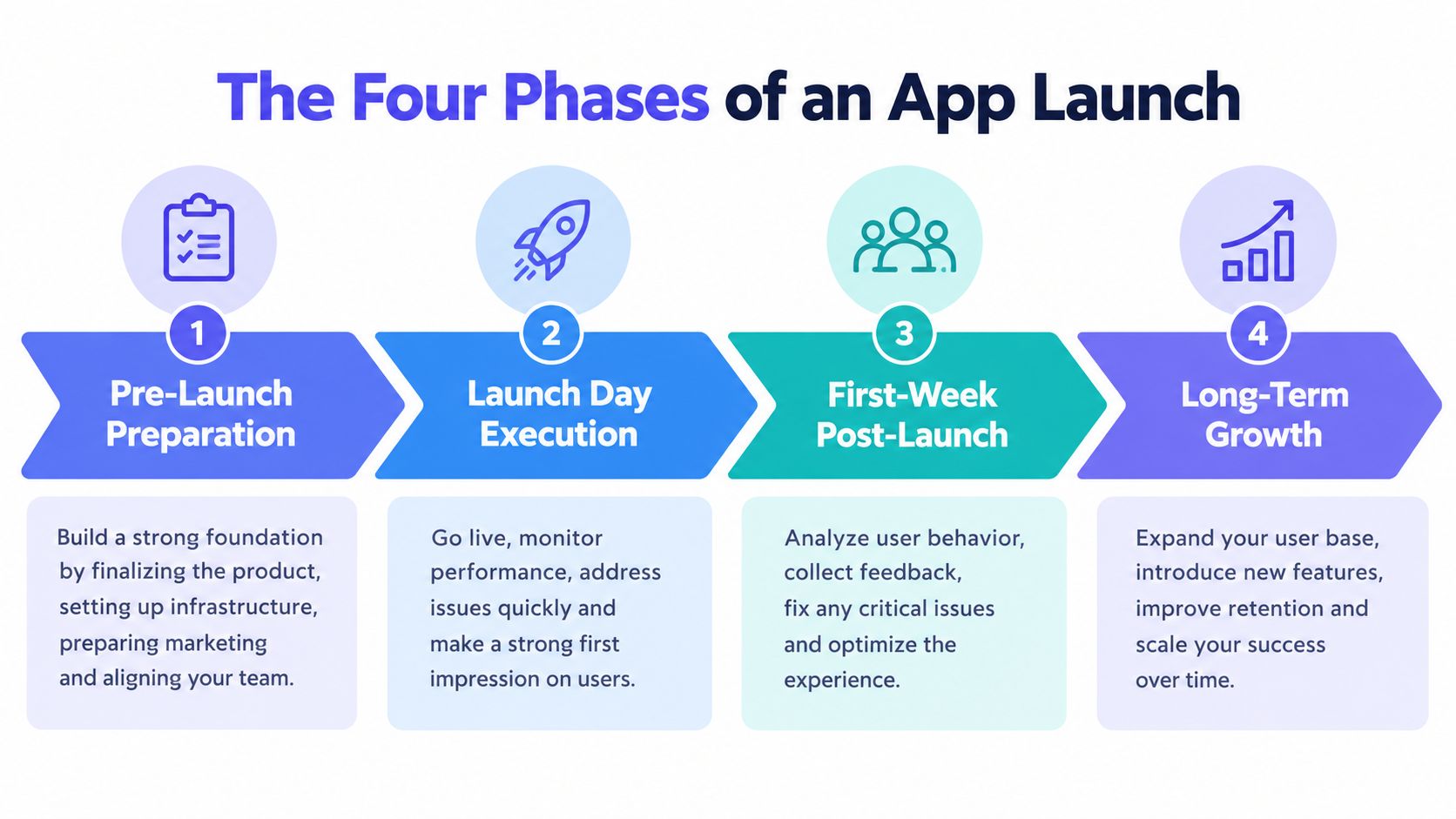
Pre-launch is where the real work happens
Most launches fail because founders spend their energy on the announcement and underinvest in the setup around it. The app store has grown from a small, centralized marketplace into a crowded distribution system, so the old idea that “being present” is enough no longer holds up. Apple's early App Store history shows how quickly discovery became competitive, and that still shapes how launch marketing works now Apple App Store history.
Launch day is a coordinated burst
Launch day is not a victory lap. It's the moment when your preparation either creates momentum or exposes weak positioning. Product Hunt's launch guidance makes the same point in a different way, because timing, assets, and readiness matter more than copying a generic calendar. If you want a practical planning aid, the sample frameworks for product launches resource is useful because it forces you to assign owners before the pressure starts.
The first week decides whether traction is real
The first week is where you learn whether your message matches user intent. That's when early comments, traffic quality, activation, and retention start to separate signal from noise. A launch that looks good for one morning can still fail if the users don't come back.
Weekly cadence keeps the launch alive
The steady cadence is the part many teams skip. They ship once, celebrate once, then disappear until the next major release. That's backward. A launch should create a repeatable operating rhythm where each week improves the next one.
Practical rule: treat every phase as a different job. Pre-launch builds attention, launch day converts it, the first week tests it, and the weekly cadence compounds it.
Pre-Launch Checklist That Actually Builds an Audience
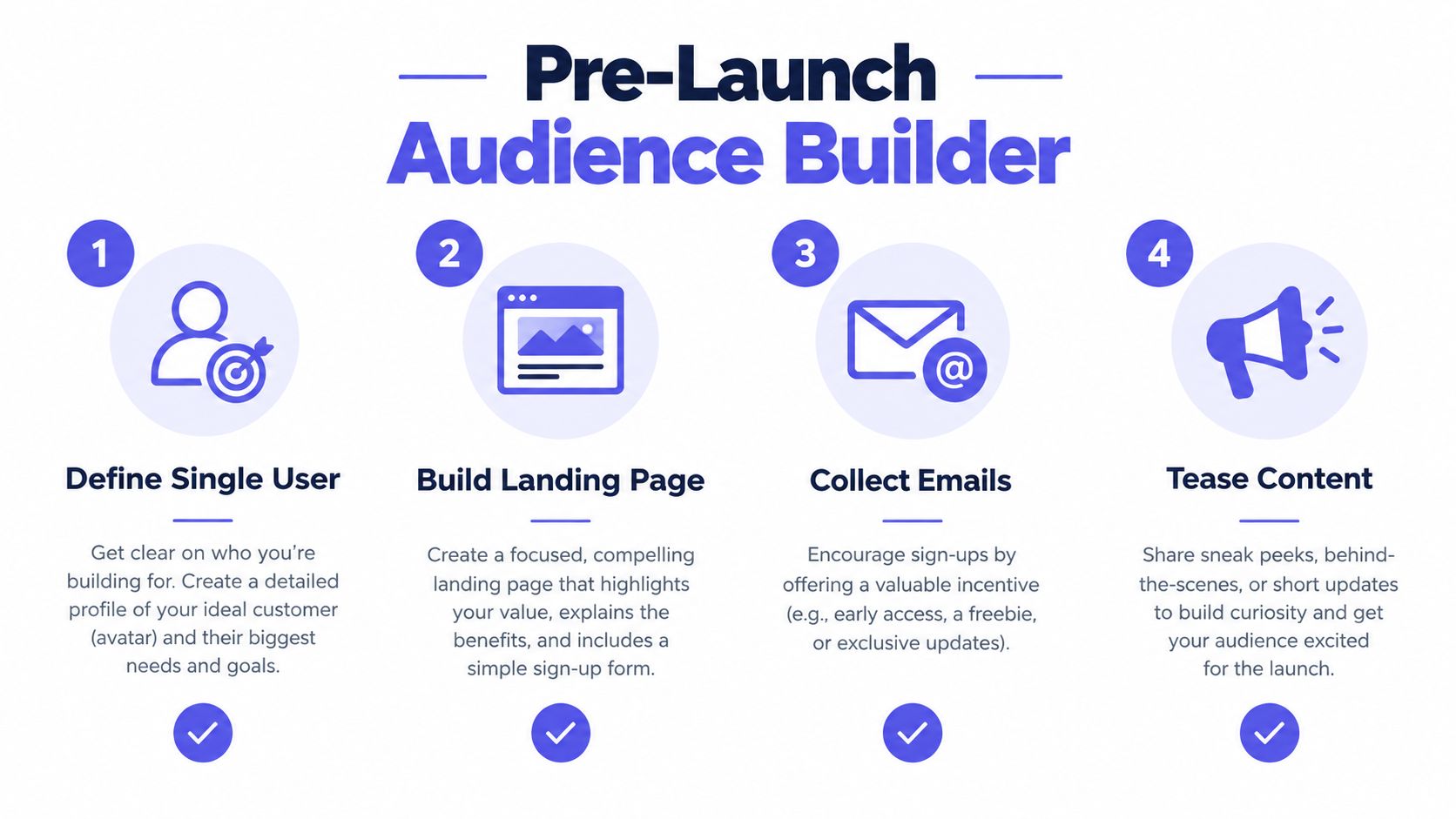
Two weeks out, define the one person and one action
Start with a single user type and a single action. If you're trying to speak to everyone, your launch copy will flatten into generic product language that nobody remembers. A founder building software needs one clear answer to “who is this for?” and “what should they do next?” before anything else goes public.
That clarity should show up everywhere, from the headline to the first line of your outreach. The strongest launch pages don't explain every feature. They explain the one outcome the user wants. That's also where a short framework helps, because the message becomes easier to repeat when the audience and action are fixed.
One week out, make the page fast and obvious
The landing page is part of the campaign, not a passive destination. Google's Mobile Site Speed documentation cites a study by SOASTA showing that pages loading one second faster saw up to a 27% increase in conversion rates Google Mobile Site Speed. That doesn't mean every page gets that result, but it does mean a slow page can waste the attention you fought to earn.
Keep the page lean. Put the value proposition high. Make the primary action obvious without scrolling. Test it on a phone, not just on a laptop.
A launch post can win curiosity. A slow page can kill it before the user ever understands the product.
Three days out, prepare the demo asset and your tracking
A short teaser is enough if it communicates the product fast. For a software launch, a 15-second motion piece often does more work than a long explainer because it can be repeated across channels without feeling heavy. If the video is built from the same landing page language and visual cues, the launch message stays consistent.
Every outbound link should already carry campaign parameters. Do that before launch day, not after. If you wait, the cleanest part of the funnel is already lost.
Launch eve, warm the list you already earned
The best launch audience is the one that already knows you. That means people who signed up, replied, commented, or showed interest before the public announcement. Send them a direct note, not a broadcast that sounds like it was written for strangers.
Use launch eve to check the basics:
- Product URL: confirm the destination still resolves cleanly.
- Video URL: verify the public asset works where it needs to work.
- Response plan: decide who answers comments and support messages.
- Message consistency: make sure the teaser, page, and email all say the same thing.
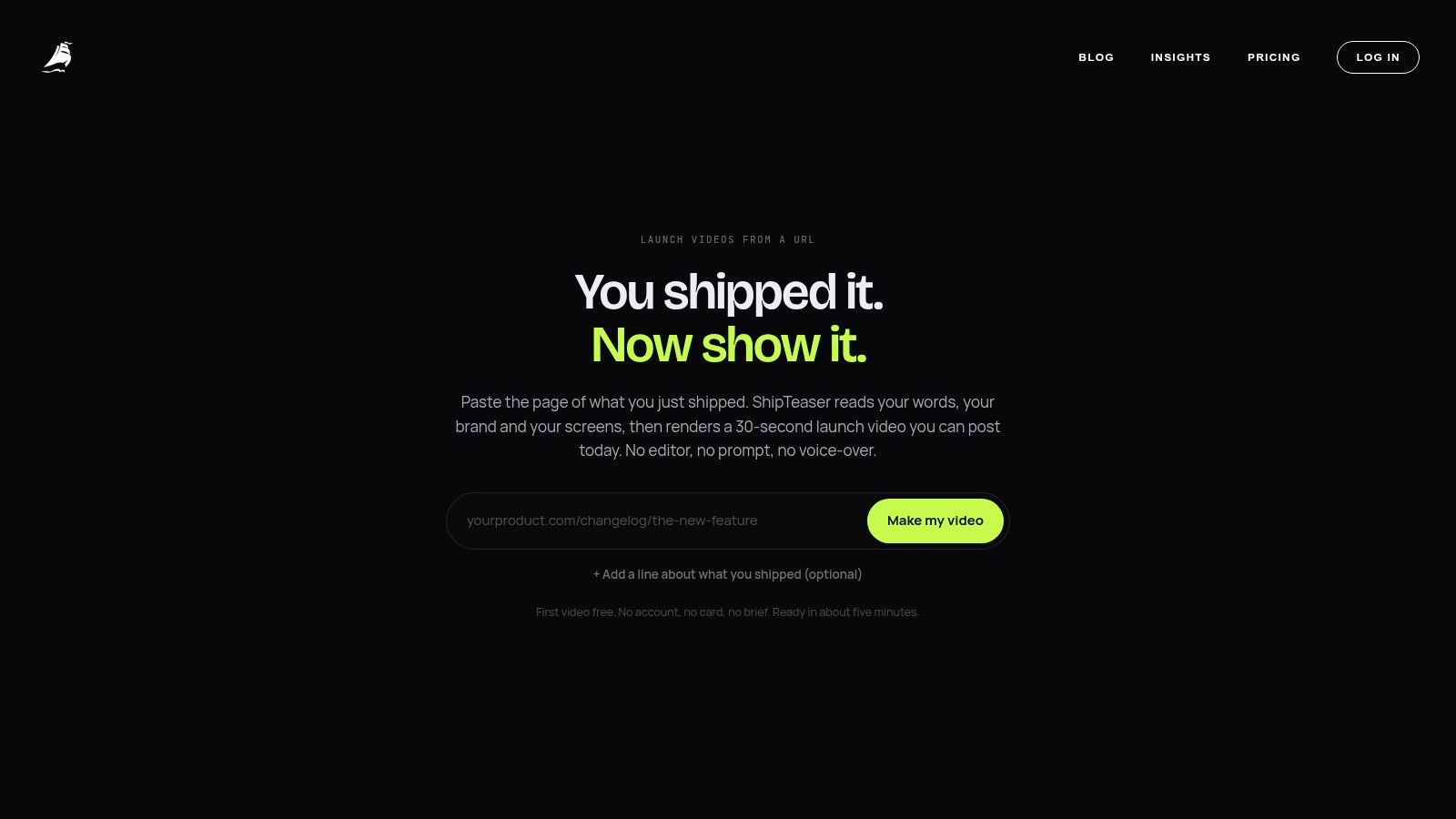
If you need a lightweight way to turn a product URL into a 15-second teaser, ShipTeaser is built for that exact input-output flow.
Designing the 15-Second Teaser That Stops the Scroll
Hook first, because muted feeds punish vague intros
A launch teaser has to explain itself before anyone unpauses anything. That's why silent motion works well in feeds, the viewer should understand the product from the first frame and still get value if they never turn audio on. The opening should show the product promise, not a logo splash and not a slow build.
The strongest first beat usually does one of three things. It names the problem, shows the result, or shows the interface outcome immediately. If your opening frame needs a narrator to make sense, it's too weak.
Build the five-scene arc, then cut the fat
The cleanest structure is hook, problem, solution, proof, CTA. Each scene has one job. The hook earns attention. The problem makes the viewer feel the pain. The solution shows what the product does. The proof gives a reason to believe it. The CTA tells the viewer what to do next.
Keep the pacing tight. Don't over-explain. Don't stack five messages into one scene. A 15-second asset has no room for detours, especially on launch day when the audience is already distracted.
Export for the channels you'll actually use
A single teaser should travel across formats, not sit in one ratio and force the team to improvise. Exporting 16:9, 1:1, and 9:16 from the same source keeps the message intact across social and product channels. That matters because the launch sequence changes by platform, even when the core story doesn't.
A founder can paste a product URL, let the page copy and brand cues guide the output, and get a usable teaser in about two minutes without touching a timeline. That's the right trade-off for launch marketing, because the bottleneck isn't artistic control, it's message volume and speed.
Choosing the Right Channel for Each Stage
A launch doesn't need every channel at full intensity. It needs the right channel at the right point in the funnel. Product Hunt, social, email, and paid each serve a different job, and if you force them all into the same role, you dilute the result.
Product Hunt rewards preparation and credibility
Product Hunt works best when the product is ready to be understood fast. Product Hunt's own launch guidance says the best day is the day you're most prepared, and that the launch day follows Pacific Time. That means the platform rewards readiness, not improvisation Product Hunt launch guidance.
Use Product Hunt when the team can support live comments, clean assets, and a clear first impression. If the launch page, teaser, and first comment all align, the community can understand the product faster.
Social rewards short hooks and clear visual proof
Social is where a tight teaser has a job to do. It should earn a click, not explain the entire roadmap. A founder who wants a structured way to think about where startup channels fit can use how startups pick social channels as a useful filter, because channel choice should follow audience behavior, not habit.
Use social to create repeated visibility. Don't dump the same post everywhere at the same time and expect fresh attention from each audience. Staging works better.
Email rewards warmth, not volume
Email is the highest-intent channel in most launch stacks because the people on the list already showed interest. That makes it ideal for the first announcement, but only if the list exists and the message is specific. If you send generic launch copy to people who barely remember you, the response will be weak.
Paid rewards precision, but only after the message is proven
Paid spend makes sense when the message and activation path are already working. Throwing budget at an unclear offer just buys more expensive confusion. Use paid after the launch window starts producing usable signals, then push the message that already performs best.
Rule of thumb: lead with the channel that matches your strongest asset. Use Product Hunt for community validation, social for repeated exposure, email for direct conversion, and paid for controlled amplification.
For a deeper channel map, the internal guide on where to launch your product helps founders avoid treating every surface like a generic announcement board.
Launch Day Operating Playbook
Launch day should feel prepared rather than dramatic. Before the clock starts, confirm every link, copy block, approval, tracking event, and support owner. That removes decisions during the first wave, when a founder's attention has the highest value.
Start at 12:01 a.m. Pacific only if someone can monitor it
Product Hunt says launch day runs on Pacific Time, and makers can launch at 12:01 a.m. Pacific Time when they have prepared for that timing Product Hunt launch guidance. The early start gives the launch more time to collect attention, but only if someone is present to respond.
Assign one person to watch comments, answer questions, check the listing, and flag support issues. A later launch with reliable coverage will outperform an early launch that sits unattended.
Spend the first hours on velocity, not vanity
Some Product Hunt analyses report that launches reaching 100 or more upvotes within the first four hours had an 82% probability of finishing in the Top 10 Product Hunt launch data. Treat that figure as directional, not guaranteed. The practical takeaway is to concentrate your outreach and response capacity early.
Use one 15-second teaser as a live experiment rather than a single-use asset. Post the same core promise with small changes to the opening frame, caption, or call to action across your launch-day placements. Record views, clicks, replies, and activated users, then keep the version that produces the strongest downstream response.
Watch for questions and answer them like a founder
A direct answer builds more trust than polished launch copy. Respond to questions about the product, audience, setup, and limitations with specific language. If the same question appears repeatedly, turn the answer into a visible FAQ or update the launch post.
Keep the response plan simple:
- Comments: answer quickly and clearly.
- Support issues: route each issue to one owner.
- Social replies: keep the core message consistent.
- Announcement email: align the inbox message with the launch thread using this guide to write a launch email.
- Leaderboard obsession: stop checking rankings once you know whether traffic is becoming real users.
The operating goal is activated users who stay. Record what happened, including which message earned attention and which objections blocked activation, so the next weekly test starts with evidence rather than guesswork.
Measuring What Actually Matters After Launch
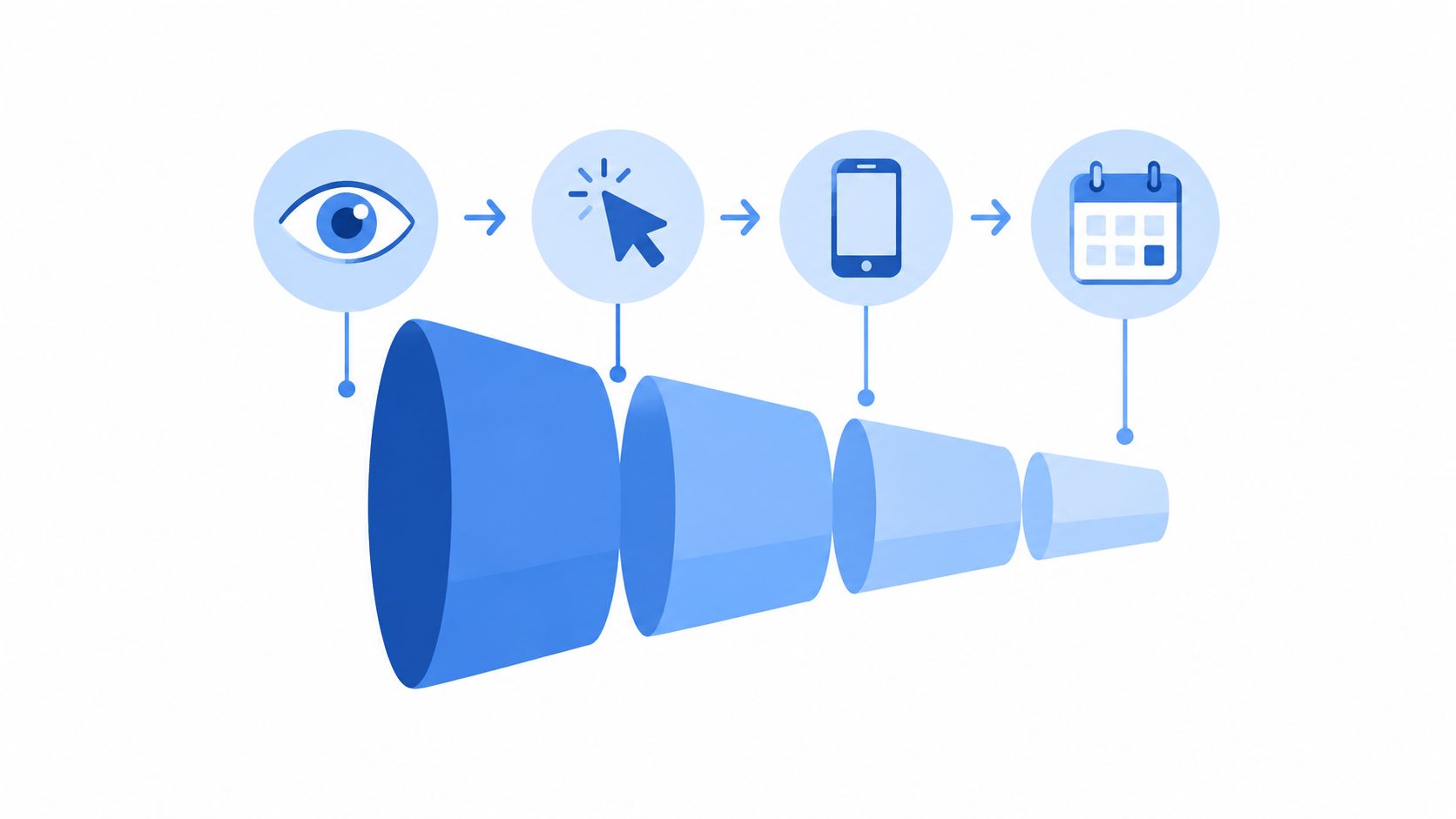
Track the full path, not just the download
A launch should be measured from impression to page visit to install or signup to activation and retention. That is a real funnel. Raw downloads alone don't tell you whether the message matched the market or whether the product earned a second visit.
The ASO benchmarks in current industry reporting put the median tap-through-to-install rate at 33.4% on iOS and 27.7% on Google Play, with top-quartile performance around 45.6% ASO benchmarks. Use those as rough comparison points, not as a target to chase blindly. If your numbers are lower, the issue might be the creative, the listing, or the audience match.
Read attribution carefully in a privacy-shaped market
App Tracking Transparency changed what clean measurement looks like. In 2026, global opt-in was reported at roughly 27%, which means most iOS attribution work depends on aggregated or probabilistic signals instead of deterministic user matching privacy-safe measurement coverage. That makes last-click thinking less reliable than it used to be.
So read the data in layers. Early numbers tell you about traffic quality. Retention tells you whether the promise was honest. Incrementality tells you whether the launch actually created demand.
Treat retention as the real success signal
If a launch video gets clicks but weak retention, the problem is rarely the click. It's usually the promise, the onboarding, or the audience fit. That's why Day-7 and Day-30 retention matter more than install volume when you're deciding whether to keep spending or keep testing.
For a compact breakdown of what to instrument and when to review it, the internal guide on product launch metrics is the right companion piece.
A Repeatable Weekly Cadence for Post-Launch Growth
A good launch creates work for the next week. That's the point. If the team treats launch day as the finish line, the campaign decays fast and the next release starts from zero again.
Run the same operating rhythm every week
A small team can sustain a simple cadence without burning out. Ship one new 15-second teaser variant. Run one A/B test against the current default. Refresh one store listing element or screenshot. Send one email to the launch list. Publish one community post.
That rhythm matters because it keeps the product visible without asking the team to reinvent the campaign each week. The content becomes an experiment stream, not a pile of isolated assets.
Use one source page to create many tests
The fastest way to keep testing is to reuse the same product URL as the source input for new teaser variants. That keeps the brand cues consistent and the turnaround short, which means the team can test message angles instead of spending days on production logistics. Different hooks, different proof points, different calls to action, same underlying product.
Good growth work increases disciplined experiments. Bad growth work increases content volume.
Shift from acquisition to re-engagement deliberately
The market is already telling you where the money goes. AppsFlyer reported that remarketing spend grew 37% to $31.3 billion and represented 29% of app-marketing investment in 2025 AppsFlyer mobile app strategies. That doesn't mean every early-stage app should pour money into remarketing immediately, but it does show that app growth increasingly depends on re-engagement, not just acquisition.
For a founder, the practical move is simple. Keep the launch message alive in onboarding, in follow-up email, and in the next teaser variant. Don't let the first campaign become a one-off artifact.
What to do when retention is weaker than expected
If Day-7 retention disappoints, resist the urge to blame the channel first. The closer issue is usually promise mismatch. Either the teaser promised too much, the onboarding asked for too much, or the product solved a different problem than the one the launch copy emphasized.
Fix the message before you scale the spend. Weak retention rarely gets better just because more people see it.
FAQ
How far in advance should a founder start app launch marketing?
Start at least two weeks before the public push, because the launch is really a sequence of prep, execution, learning, and follow-up. The earlier work should define the audience, clean up the page, and warm the list so launch day isn't carrying the whole burden.
Is a paid budget necessary for a first launch?
No, not by default. A first launch can work with owned and community channels if the message is strong and the timing is tight, but paid spend only makes sense once the landing page and retention path are already giving you usable signals.
Should a founder do a soft launch on Product Hunt?
Yes, if the goal is to test positioning and collect real feedback before a bigger push. A soft launch is useful when the team wants to pressure-test the message, but it shouldn't be treated as a substitute for a prepared public launch window.
What should I do if Day-7 retention is lower than expected?
Treat that as a message and product fit problem before you treat it as a distribution problem. Review the teaser, the landing page, and the first-session experience together, then adjust the promise or the onboarding before you add more traffic.
Can one teaser really be reused across a weekly cadence?
Yes, if the source input stays consistent and the message is modular. The point isn't to make one video do everything forever, it's to use one clear product story to generate a series of disciplined variations that keep the launch learning.
If you're shipping a software product and want launch assets you can reuse every week instead of rebuilding from scratch, ShipTeaser turns a product URL into a 15-second teaser built for social and launch posts. Visit ShipTeaser and use it to keep your app launch marketing moving after the first announcement fades.